
Who can attest documents in the UAE: A guide for Filipino expats

You finally land that job offer in the UAE, or you’re ready to bring your family over, and then someone tells you your documents need to be “attested.” You ask around, get three different answers, and suddenly you’re not sure if you should go to a notary, the embassy, or some office you’ve never heard of. This confusion is incredibly common among Filipino expats, and it costs people real time and money. This guide breaks down exactly who is authorized to attest documents in the UAE, what types of documents are covered, and how to move through the process without unnecessary delays.
Table of Contents
Key Takeaways
Point | Details |
Attestation means official authentication | UAE and Philippine authorities only recognize documents verified by licensed entities like ministries or embassies. |
Know your document type | Personal, educational, and professional documents usually need attestation to be accepted abroad. |
Follow each required step | Proper sequencing—local notary to embassy—protects against mistakes, delays, and rejection. |
Apostille may substitute attestation | Some documents only require an apostille depending on country agreements and the document’s type. |
Local requirements change often | Always double-check current rules with the receiving agency to avoid surprises. |
What is document attestation and why does it matter?
Attestation sounds like a legal term reserved for lawyers, but the concept is actually straightforward. Document attestation is verifying and authenticating documents for use in another country. When a UAE employer asks for an attested diploma, or a Philippine government office requires an attested marriage certificate, they’re asking for proof that the document is genuine and recognized by official authorities.
Here’s where people get confused: attestation, apostille, and legalization are not the same thing.
Attestation is the traditional process where multiple government bodies verify a document step by step.
Apostille is a simplified certification used between countries that are part of the Hague Convention. It replaces the multi-step attestation chain with a single stamp.
Legalization is a broader term that sometimes refers to the entire chain of authentication, including embassy verification.
“Attestation is the official process of verifying a document’s authenticity so it can be legally recognized in a foreign country.”
For Filipino expats in the UAE, attestation matters in very specific, high-stakes situations. Job applications often require attested educational certificates. Sponsoring a spouse or child for a UAE residency visa requires attested marriage and birth certificates. Enrolling children in schools sometimes requires attested academic records. Philippine government agencies also require attested documents when processing overseas worker benefits, property transactions, or legal matters back home. Getting this wrong doesn’t just cause delays. It can mean rejected visa applications, failed job offers, or legal complications in both countries.
Who is authorized to attest documents in the UAE?
This is the central question, and it has a clear answer. Attestation authorities in UAE include government ministries, embassies, consulates, and notary publics. Each plays a specific role in the chain, and understanding who does what prevents you from wasting time at the wrong office.

Here’s a breakdown of the main authorized entities:
Authority | Role | When you use them |
UAE Ministry of Foreign Affairs (MOFA) | Final UAE-side attestation for most documents | After local notary and Ministry of Justice steps |
Philippine Embassy or Consulate in UAE | Authenticates Philippine-issued documents | When submitting documents for use in the Philippines |
Notary Public | First-level verification of signatures and copies | At the start of most attestation chains |
UAE Ministry of Education | Attests educational certificates | Required before MOFA for academic documents |
UAE Ministry of Health | Attests medical and health-related documents | For healthcare professionals and medical records |
Now, who cannot legally attest documents? Private businesses, typing centers, and individuals without a government license have no authority to issue official attestations. Many expats fall into the trap of paying an unofficial “agent” who stamps documents with what looks like an official seal. These are fraudulent, and using them can get your documents rejected or worse.
Pro Tip: Before starting the process, contact the receiving institution in the Philippines or UAE and ask specifically which authority’s attestation they require. Different employers, schools, and government agencies have different requirements, and confirming upfront saves you from repeating steps.
What types of documents require attestation?
Not every piece of paper you own needs to go through the attestation process. But most personal status documents and education or professional certificates for expats do require attestation when used in official cross-border matters.
Here are the most common document categories that Filipino expats in the UAE typically need to attest:
Birth certificates — Required for family visa sponsorship, school enrollment, and inheritance matters.
Marriage contracts — Needed for spousal visa applications, name changes, and family-related legal processes.
Diplomas and transcripts — Essential for UAE work visas, professional licensing, and job applications.
Employment contracts — Sometimes required when applying for loans, housing, or government benefits in the Philippines.
Business licenses and commercial documents — Necessary for Filipinos running businesses or entering contracts across both countries.
Medical certificates — Required for healthcare worker licensing and certain visa categories.
Police clearance certificates — Often needed for residency visa renewals and employment background checks.
Each document type follows a slightly different path. An educational certificate from a Philippine university, for example, typically needs to be authenticated by the Philippine Department of Education or CHED (Commission on Higher Education), then by the Philippine Department of Foreign Affairs, and then by the UAE Embassy in Manila before it even arrives in the UAE. Once in the UAE, it may still need to go through the UAE Ministry of Education and MOFA.
A significant number of visa application delays in the UAE are directly linked to incomplete or incorrectly attested documents. Rushing the process or skipping steps almost always results in rejection and resubmission, which doubles your timeline. Use our guide to documents for attestation to check the specific requirements for your document type before you begin.
Step-by-step guide to the attestation process
The attestation process follows a prescribed sequence involving a notary, local authorities, embassies, and sometimes MOFA. Skipping any step typically means starting over. Here’s how the general process works for Filipino expats in the UAE:
Typical attestation sequence for Philippine-issued documents:
Step | Action | Authority |
1 | Authenticate at the issuing agency (e.g., PSA, CHED, PRC) | Philippine government agency |
2 | Authenticate at the Philippine Department of Foreign Affairs (DFA) | DFA Philippines |
3 | Authenticate at the UAE Embassy in Manila | UAE Embassy in the Philippines |
4 | Attest at UAE MOFA upon arrival in the UAE | UAE MOFA |
Common pitfalls to watch out for:
Missing signatures: If the document has an unsigned section, the entire chain gets rejected.
Incomplete copies: Some authorities require certified true copies, not originals. Submitting the wrong format wastes time.
Name discrepancies: Your name must appear exactly the same across all documents. A middle name spelled differently on your passport vs. your diploma is a common problem.
Expired documents: Certain certificates like police clearances have validity periods. Submitting an expired document restarts the process.
Language issues: Documents in Filipino may need certified English translations before certain UAE authorities will accept them.
Pro Tip: Keep a physical folder and a digital copy of every document at every stage. Request official receipts from every office you visit. This protects you if documents are lost, and it gives you a clear record if you’re ever questioned about the authenticity of your paperwork.
Apostille vs. attestation: What’s the difference for Filipino expats in the UAE?
This is where things get genuinely interesting, especially because the rules have changed in recent years. Some countries, including the Philippines, now accept apostille certification as an alternative to the traditional multi-step attestation chain.
The Philippines officially joined the Hague Apostille Convention in 2019. This means that Philippine-issued documents can now receive an apostille stamp from the Philippine DFA, which is recognized by all other Hague Convention member countries. This simplifies the process significantly when the destination country is also a member.
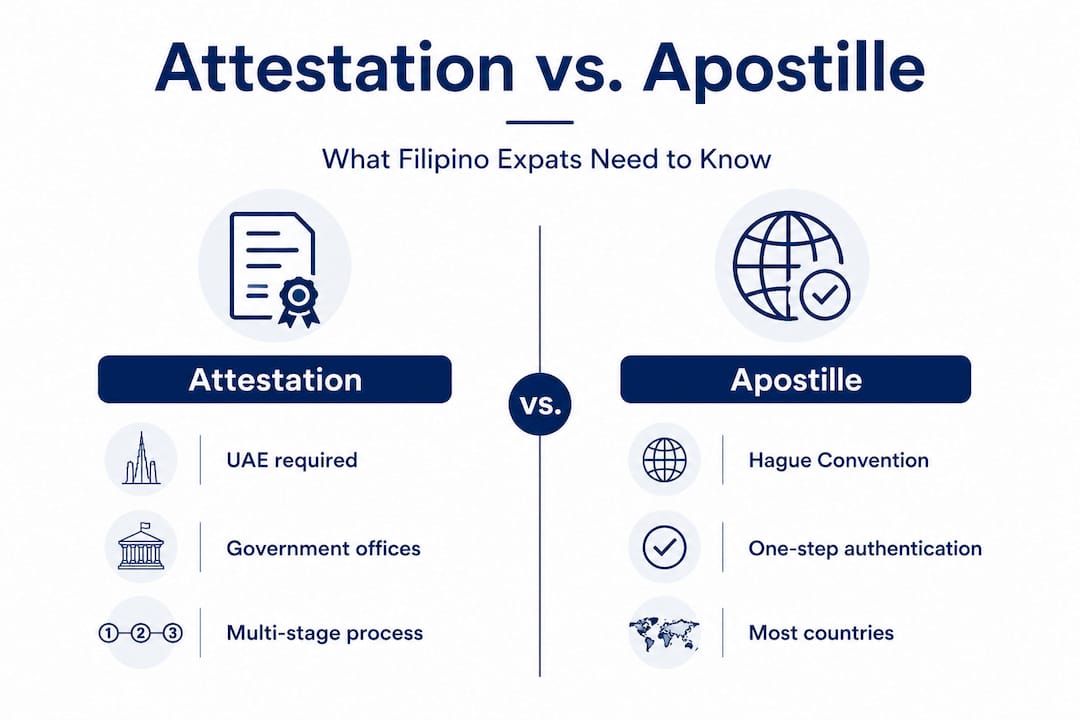
Here’s the key comparison:
Feature | Apostille | Traditional attestation |
Used when | Both countries are Hague Convention members | One or both countries are not Hague members |
Steps involved | Single apostille stamp from DFA | Multi-step chain through several authorities |
Recognition | Automatic between member countries | Requires each authority to verify separately |
Cost | Generally lower | Can be higher due to multiple offices |
Speed | Usually faster | Can take significantly longer |
However, the UAE is not a member of the Hague Apostille Convention. This is a critical point that many Filipino expats miss. Because the UAE is not a Hague member, documents intended for use specifically within the UAE still require the traditional attestation chain, not just an apostille.
“Apostille certification applies only when both the issuing and receiving countries are members of the Hague Convention.”
Here’s a quick checklist to determine which process you need:
Is the document going to be used in the UAE? Use traditional attestation.
Is the document going to be used in a Hague Convention member country other than the UAE? An apostille may be sufficient.
Is the document Philippine-issued and going to a Hague member country? Get the DFA apostille stamp.
Not sure? Check the updates on apostille for the Philippines or contact the receiving institution directly.
The reality most expats miss about document attestation
Here’s something the official guides and embassy websites won’t tell you: knowing the rules is only half the battle. The other half is managing the unpredictability of the process itself.
Checklists help, but they’re often outdated. Government offices update their requirements without much fanfare, and what was true six months ago may not be true today. We’ve seen Filipino expats arrive at MOFA with a perfectly organized set of documents, only to be told that one office changed its procedure last week. No announcement. No website update. Just a new requirement at the counter.
The expats who get through the process smoothly are not necessarily the ones who know every rule. They’re the ones who are organized, patient, and proactive. They call ahead. They bring extra copies of everything. They don’t assume that what worked for their colleague will work for them, because document requirements can vary by employer, by visa type, and even by the individual officer handling the case.
There’s also a common belief that hiring an agent solves everything. Agents can be genuinely helpful for navigating the logistics, but they are not a substitute for your own involvement. Some steps, like signing forms or appearing in person for biometrics, simply cannot be delegated. And not all agents are equally reliable. An agent who promises to handle everything without your input is a red flag, not a convenience.
The smartest approach? Use insider attestation tips from people who’ve done it recently, verify requirements directly with the relevant offices, and treat every document as if it needs to be perfect before it leaves your hands. Preparation beats expertise every time.
Let us help you streamline your attestation journey
If reading through all of this makes the process feel more complicated, not less, you’re not alone. The attestation chain is genuinely complex, and even small errors can set you back weeks.
That’s exactly why we built Harris N Charms. We specialize in document attestation and apostille services for Filipino expats in the UAE, and we’ve helped hundreds of clients move through the process without the usual stress and guesswork. Whether you need a single document attested or an entire package prepared for a family visa, our team knows exactly what each authority requires and how to get it right the first time. Explore our attestation services to see how we can help, or book a consultation to talk through your specific situation. You can also start here to learn more about what we offer.
Frequently asked questions
Can I attest documents myself in the UAE?
No. Document attestation in the UAE requires recognized authorities such as notaries, embassies, or government ministries. Private individuals cannot legally attest official documents for use abroad.
How long does the attestation process usually take?
The process typically takes between 3 and 14 business days, depending on document type and the workload of the relevant authority. Turnaround varies between ministries and offices, so building extra time into your timeline is always a good idea.
When do I need an apostille instead of attestation?
You need an apostille when both the issuing and receiving countries are members of the Hague Convention. Since the UAE is not a Hague member, apostilles replace attestation only for documents going to other Hague member countries, not for use within the UAE.
Are educational certificates required to be attested for UAE work visas?
Yes. Attestation of education certificates is mandatory for work visa processing in the UAE. This typically involves authentication by the issuing institution, the Philippine DFA, the UAE Embassy in Manila, and UAE MOFA.
Recommended
Comments