
Degree Attestation for Filipino Expats: 2026 Guide

Working hard for your degree is one thing. Getting foreign authorities to accept it is another. If you’re a Filipino expat preparing to work, study, or migrate abroad, understanding what is degree attestation could save you weeks of delays and a lot of frustration. Attestation is not proof that you graduated. It is official confirmation that the signatures and seals on your academic documents are legitimate. That distinction matters more than most people realize, and getting it wrong is one of the most common reasons documents get rejected overseas.
Table of Contents
Key takeaways
Point | Details |
Attestation confirms document authenticity | It verifies signatures and official seals, not whether you actually completed your degree. |
Philippines uses DFA Apostille since 2019 | Since May 2019, the DFA replaced Red Ribbon consularization for Hague Convention countries. |
Destination country determines the process | Hague Convention members need an apostille; non-members require consular legalization instead. |
Digital apostille is now available | Electronic apostille processing reduces personal appearances and speeds up turnaround for eligible documents. |
Errors are easy to avoid with preparation | Confirming issuing authority and destination requirements upfront prevents the majority of rejections. |
What is degree attestation and why it matters
Degree attestation is the official process of authenticating academic documents through recognized government bodies so they can be legally accepted in a foreign country. Think of it as a chain of trust. Each authority in the chain verifies that the signature or seal of the previous authority is genuine, all the way from your issuing university to the final destination.
Here’s the part most people misunderstand. The U.S. Department of State makes this explicit: authentication certifies the signature of the official who signed the document, not the content of the degree itself. That means your transcript can be fully attested even if the grades listed on it are never reviewed by the authenticating authority. Employers and universities handle content verification separately. Attestation is purely about paperwork legitimacy.
Why does this matter for you as a Filipino expat? Foreign employers, universities, and immigration offices in countries like the UAE, Saudi Arabia, and Germany have no way to independently confirm whether a Philippine university diploma is genuine. Attestation gives them a government-backed assurance that the document is real and was issued by a legitimate institution.
Here is what the degree attestation process involves at its core:
Verification that the issuing institution’s signature or seal is authentic
Confirmation by a recognized Philippine authority such as CHED, DepEd, or TESDA
Authentication by the Department of Foreign Affairs (DFA) through apostille or legalization
Embassy or consular attestation for countries outside the Hague Convention
Pro Tip: Never assume that a certified true copy of your diploma is the same as an attested diploma. A certified copy only confirms the photocopy matches the original. Attestation goes further by verifying the document’s official origin through government channels.
Steps in the degree attestation process for Filipino documents
The degree authentication process for Philippine academic credentials follows a structured path. The exact steps depend on where your documents are headed, but the general workflow runs like this.
Get your original document certified by the issuing institution. Your university, college, or vocational school must first certify that the diploma or transcript is a true and original copy from their records.
Obtain verification from the relevant Philippine education authority. Depending on the document, this is either the Commission on Higher Education (CHED), the Department of Education (DepEd), or TESDA for technical-vocational credentials. They confirm the institution and document are registered under their authority.
Submit to the DFA for apostille or authentication. Since May 2019, the Philippines uses DFA Apostille for documents bound for Hague Convention member countries. This replaced the old Red Ribbon system. The apostille is a standardized certificate attached to your document that is recognized across all 125+ Hague Convention member countries.
Proceed to embassy legalization if the destination is a non-Hague country. If your destination country is not a Convention member, you will need an additional step: having your document legalized by that country’s embassy in the Philippines.
Submit your attested documents to the foreign authority. Once complete, your documents are ready for submission to a foreign employer, university, or government office.
For the UAE specifically, there is an additional layer. After the DFA apostille, you typically need Ministry of Foreign Affairs (MOFA) attestation in the UAE as well. Harrisncharms has a detailed breakdown of this in their UAE academic certificate attestation guide.
One major development worth knowing: the Philippines has moved toward a digital apostille system that allows fully electronic submission and issuance for certain documents. This reduces the need for in-person appearances and significantly shortens processing time for eligible academic records.
Pro Tip: Book your DFA apostille appointment as early as possible. Walk-in slots are rare. Online scheduling through the DFA’s official portal fills up fast, especially during peak months before academic year starts.
How destination country requirements affect your attestation
Not every country plays by the same rules. This is where many Filipino expats run into trouble. The authentication method you need depends entirely on whether your destination country has signed the Hague Apostille Convention.
Here is a practical comparison to help you see the difference at a glance.
Destination Type | Authentication Required | Steps Involved | Example Countries |
Hague Convention member | DFA Apostille only | University cert → CHED/DepEd/TESDA → DFA Apostille | USA, Germany, Australia, Spain |
Non-Hague Convention member | Consular legalization | University cert → CHED/DepEd/TESDA → DFA authentication → Embassy legalization | UAE (partial), Saudi Arabia, China |
UAE (employment use) | Apostille + MOFA UAE | Full Philippine chain → UAE MOFA attestation | UAE |
For Filipino workers heading to the UAE, the process does not stop at the DFA. The UAE requires that attested documents go through its own MOFA for final recognition. Countries like Saudi Arabia also have their own embassy attestation requirements on top of the Philippine chain. Embassy attestation for non-Hague countries often involves stamps, holograms, and additional certificates issued by the receiving country’s consulate.
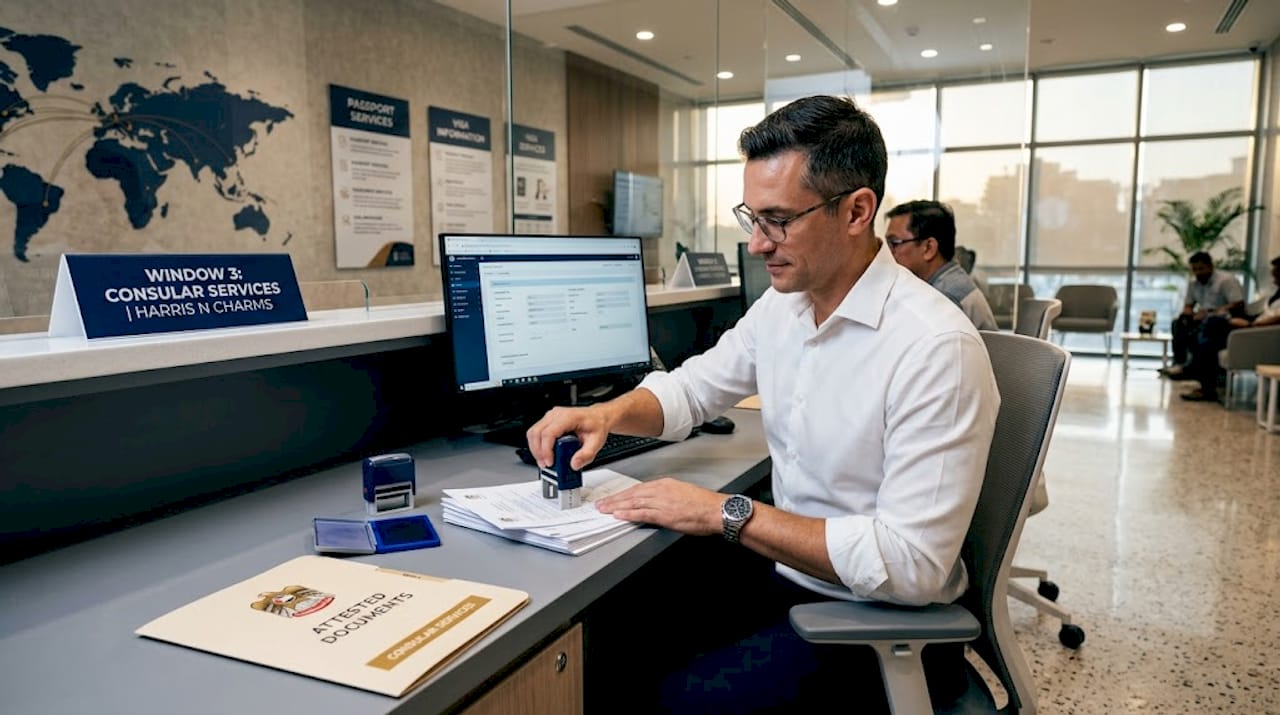
The practical consequence: getting an apostille when your destination requires embassy legalization will not help you. Your documents will be rejected. This is why knowing your destination country’s exact requirements before you start is not optional.
Common pitfalls and how to avoid them
The degree attestation process has a clear path, but there are several places where things go wrong. Most of these mistakes are preventable.
Confusing attestation with proof of graduation. Attestation only verifies the legitimacy of the document’s signatures and seals. It does not tell a foreign employer that you completed your degree. Employers run their own credential checks for that.
Not confirming destination country requirements. Filipino expats often assume one apostille fits all destinations. As noted in the Philippine Apostille Guide, you must identify the issuing authority of your document and confirm whether the destination requires an apostille or consular legalization.
Missing CHED or DepEd authentication. Some applicants go directly to the DFA without first having CHED or DepEd authenticate the document. The DFA will not process a document that has not gone through the correct education authority first.
Assuming all documents qualify for digital apostille. Digital apostille eligibility depends on document type and the platform used. Not every academic record qualifies yet, so check before planning a fully digital process.
Waiting too long. The entire chain can take two to four weeks under normal conditions. If embassy legalization is required, add another week or more. Starting this process after you already have a job offer in hand is a recipe for stress.
Pro Tip: Before you start the process, visit or call your university’s registrar to confirm they can issue a document in the format required for authentication. Some older documents need to be reissued before they can be processed by CHED or DepEd.
Using your attested degree abroad
Once you have your fully attested degree, you need to know how to present it correctly to the right authorities. The answer depends on what you are using it for.
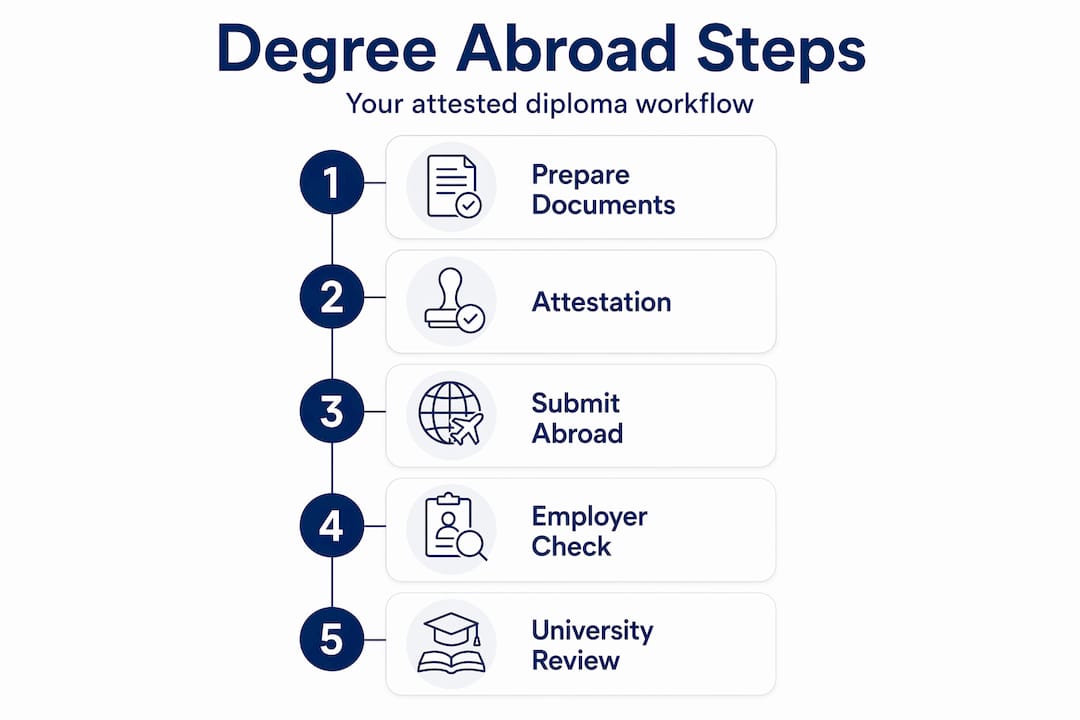
For employment abroad, submit your attested diploma and transcript directly to your employer’s HR department or recruitment agency. Many UAE employers require MOFA-attested copies. Some also ask for certified translations if your documents are in Filipino. If that is the case, the translation must also be attested. You can find a step-by-step walkthrough in Harrisncharms’ guide on legalizing Philippine documents for the UAE.
For foreign universities, they typically want attested transcripts and diplomas as part of your enrollment package. Some universities also require a separate credential evaluation from a recognized body, which is distinct from attestation.
For immigration and visa purposes, the requirements vary by country and visa category. Always confirm with the receiving embassy or immigration office whether they need an attested degree, a credential evaluation, or both.
One thing to keep in mind: attested documents are not permanent. Some countries set an expiry period on accepted attestations, typically one to two years. If your job changes or your visa lapses, you may need to go through the process again. Keep digital and physical copies of all attested documents stored safely.
My honest take on degree attestation after years of helping Filipino expats
I’ve helped hundreds of Filipino expats prepare their documents for work and study abroad, and I can tell you the same problems keep showing up. The biggest one is not the bureaucracy. It’s the assumption that everyone else already has it figured out.
Most people I work with are surprised to learn that the apostille does not apply to the UAE the way it does to, say, Germany. The UAE has its own additional MOFA layer that catches people off guard after they’ve already gone through the full Philippine chain. I’ve seen job offers nearly fall through because of this single oversight.
My advice: start with the destination, not the document. Before you gather a single paper, confirm exactly what the foreign employer, university, or embassy requires. Then work backwards. The digital apostille adoption is genuinely good news for anyone whose documents qualify. It’s faster, more accessible for expats already abroad, and reduces the logistical headache of coordinating in-person appearances.
What I keep telling people is this: attestation is not just paperwork. It’s the thing that makes your years of education count in a foreign country. Treat it with the same seriousness you gave your studies.
— Harris
Let Harrisncharms take the complexity off your plate

If you’ve read through this guide and the process still feels like a lot to manage from abroad, you’re not alone. At Harrisncharms, we specialize in document attestation services for Filipino expats in the UAE. We handle every step of the process: from CHED and DepEd authentication to DFA apostille coordination and UAE MOFA attestation. Whether your documents need a standard apostille or a full consular legalization chain, we know exactly what each destination requires and how to get it done without back-and-forth delays. We also support clients with Philippine school document apostille and embassy submissions. Reach out to Harrisncharms and let us help you get your credentials recognized the right way.
FAQ
What is degree attestation in simple terms?
Degree attestation is the official process of verifying that the signatures and seals on your academic documents are genuine, so they are accepted by foreign governments, employers, or universities. It does not prove you completed your degree. It proves your document is real.
What is the difference between apostille and embassy attestation?
An apostille is used for countries that are members of the Hague Convention and is issued by the DFA in the Philippines. Embassy attestation is required for non-member countries and involves an additional legalization step at that country’s embassy or consulate.
Do I need degree attestation for UAE jobs?
Yes. For most UAE employment purposes, your Philippine academic documents need to go through the full chain: CHED or DepEd authentication, DFA apostille, and then UAE MOFA attestation. Skipping any step will likely result in your documents being rejected.
How long does the degree attestation process take?
The timeline depends on the destination and document type, but expect two to four weeks for standard processing in the Philippines. Adding UAE MOFA attestation extends that by several more business days. Starting early gives you the most flexibility.
Can I use a digital apostille for my degree?
The Philippines has introduced a digital apostille system that works for eligible electronic documents. However, not all academic records qualify yet. Check with the DFA and confirm whether your specific document type and issuing institution support the digital route before planning around it.
Recommended
Comments