
How to prepare attestation papers for Filipinos in the UAE

Getting your documents attested in the UAE is not just a formality. For many Filipino expatriates, it is the difference between landing a job, completing a visa application, or resolving a legal matter on time. Yet the process trips up thousands of Filipinos every year because the steps are spread across multiple agencies in two countries, and a single missing seal can send you back to square one. This guide walks you through exactly what to prepare, where to go, and how to avoid the most costly mistakes so your attestation experience is as smooth as possible.
Table of Contents
Understanding attestation: What you need and why it matters
Gathering requirements: Tools, paperwork, and timelines
How to process attestation papers: Step-by-step guide
Troubleshooting and verification: Avoiding common mistakes
A fresh perspective: Attestation is more about strategy than paperwork
Seamlessly prepare your attestation papers with expert support
Frequently asked questions
Key Takeaways
Point | Details |
Know your documents | Identify exactly which papers need attestation based on your goal in the UAE. |
Prepare requirements early | Begin collecting all documents and notarizations before you need them to avoid delays. |
Follow each step | Complete the proper sequence of authentication and submission for recognition in the UAE. |
Avoid common mistakes | Review seals, signatures, and fees to prevent rejections or setbacks. |
Leverage expert help | Consider using professional services for smoother, faster document attestation. |
Understanding attestation: What you need and why it matters
Attestation is the official process of verifying that a document is genuine and that the signatures and seals on it are authentic. In the UAE context, this means a Philippine-issued document must be certified by several layers of authority before UAE government agencies, employers, or courts will accept it as valid.
You will most commonly need attested documents when applying for a work visa, registering a marriage in the UAE, enrolling children in school, opening a business, or dealing with court proceedings. The UAE MOFAIC attestations guide outlines the general framework for document verification, though it does not cover Philippines-specific requirements in detail. That gap is exactly why many Filipinos end up confused or delayed.
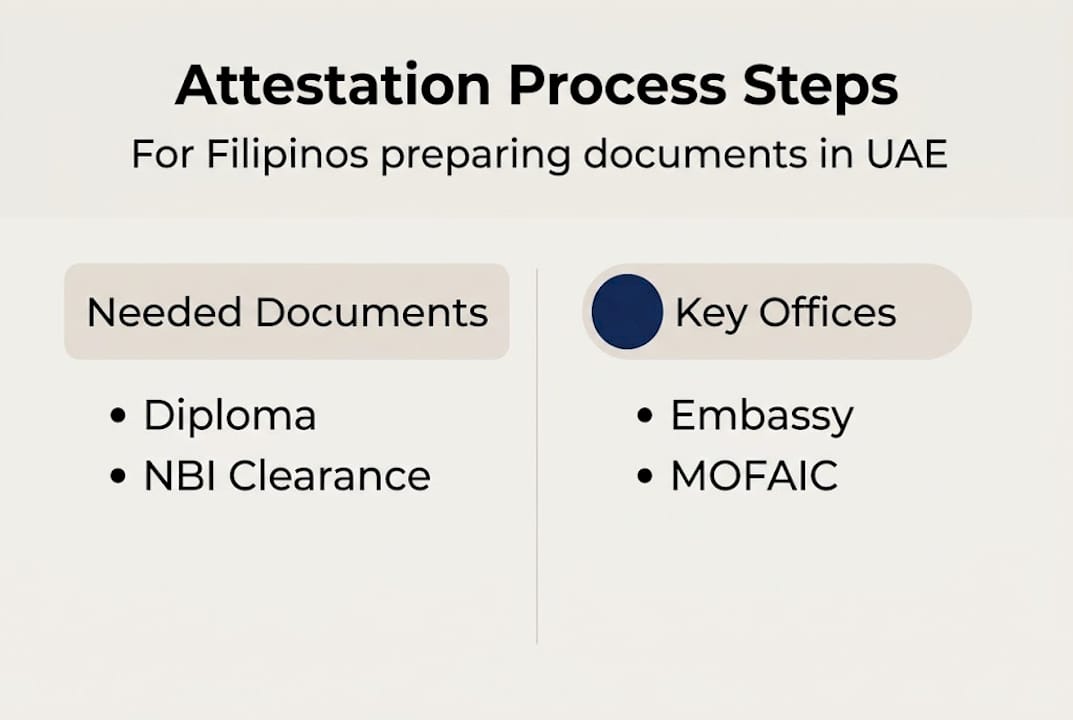
Common documents that Filipino expats need attested include:
College diplomas and transcripts of records
NBI (National Bureau of Investigation) clearances
Marriage contracts issued by the Philippine Statistics Authority (PSA)
Birth certificates from the PSA
Police clearances
Special Power of Attorney (SPA) documents
Employment certificates and experience letters
Medical certificates for specific visa categories
Document type | Typically required for | Attestation urgency |
College diploma | Professional license, employment | High |
NBI clearance | Employment, residency visa | High |
PSA marriage contract | Spouse visa, family reunification | High |
PSA birth certificate | Dependent visa, school enrollment | Medium |
Special Power of Attorney | Legal transactions, property | High |
Employment certificate | Visa renewal, job transfer | Medium |
One thing that surprises many Filipinos is that even documents you have held for years may need to be reissued before attestation. Older documents sometimes lack the proper security features or current official signatures that UAE authorities require. Always verify the document’s issue date and format before starting the attestation process.
Pro Tip: Before you gather a single paper, contact your prospective employer or the UAE government agency requiring the document. Ask them specifically which version, format, and attestation level they need. This one step alone can save you weeks of rework.
For broader attestation guidance that covers real scenarios faced by Filipinos in the UAE, reviewing community-focused resources can help you anticipate issues before they arise.
Gathering requirements: Tools, paperwork, and timelines
Preparation is where most people either win or lose the attestation game. Walking into this process without a complete set of documents is like showing up to a job interview without your resume. The paperwork you need falls into two categories: the primary documents themselves and the supporting items that accompany them through each stage.
Here is a practical checklist before you begin:
Original documents (diploma, NBI clearance, PSA certificates, etc.)
Photocopies of each document (at least three sets)
Valid Philippine passport (original and copies)
UAE residence visa copy
Emirates ID copy
Passport-sized photos (some offices still require these)
Payment for government fees (cash or card depending on the office)
Prepaid courier envelope if using courier services for DFA processing
One of the trickiest parts for Filipinos already living in the UAE is obtaining fresh Philippine documents from abroad. The PSA now offers an online ordering system through PSAHelpline.ph, which ships certified documents internationally. The DFA also has an online appointment system for passport-related concerns. For NBI clearances, the NBI Clearance Online portal allows overseas Filipinos to apply, though the physical pickup or delivery still requires coordination.
Requirement | Original needed | Photocopy accepted |
PSA birth/marriage certificate | Yes, for submission | Yes, for reference only |
College diploma | Yes, original for attestation | Yes, for file copy |
NBI clearance | Yes, must be recent (within 6 months) | No |
Passport | Yes, for identity verification | Yes, for submission |
UAE residence visa | No | Yes |
Emirates ID | No | Yes |
Timelines are something many Filipinos seriously underestimate. PSA document requests from abroad can take two to four weeks for delivery. NBI clearance processing for overseas applicants can take a similar amount of time. DFA authentication in the Philippines typically takes five to seven working days for regular processing, or two to three days for expedited service. Add courier time between countries and you are looking at a minimum of six to eight weeks from start to finish if everything goes smoothly.
The UAE MOFAIC attestations guide confirms that attestation timelines vary based on document type and volume of applications, which reinforces why early planning is critical.
Pro Tip: Start your attestation process at least three months before you actually need the documents. Government offices experience backlogs, especially around Philippine holidays and peak hiring seasons in the UAE. Starting early gives you a buffer for unexpected delays.
For more detailed document gathering tips specific to Filipinos in the UAE, practical community advice can fill in the gaps that official government websites often leave out.
How to process attestation papers: Step-by-step guide
Once you have all your documents ready, the actual attestation process follows a specific sequence. Skipping or reversing any step will result in rejection. Here is the correct order for most Philippine documents destined for use in the UAE.
The standard attestation sequence:
Notarization in the Philippines. Your document must first be notarized by a licensed notary public in the Philippines. This applies to documents like Special Power of Attorney, affidavits, and other legal papers. PSA-issued documents like birth and marriage certificates are already considered official and may skip this step.
Authentication by the Department of Foreign Affairs (DFA) in the Philippines. The DFA’s Office of Consular Affairs authenticates the document by verifying the signature of the notary or the issuing government official. You can book an appointment through the DFA online system. The DFA will place a red ribbon or apostille sticker on the document.
Attestation by the UAE Embassy in Manila. After DFA authentication, the document goes to the UAE Embassy in the Philippines for attestation. The UAE Embassy verifies the DFA seal and adds its own certification. This step is required for most documents intended for official use in the UAE.
Final attestation by UAE MOFAIC. Once you are in the UAE, the document is submitted to the Ministry of Foreign Affairs and International Cooperation (MOFAIC) for final attestation. This is the last official stamp that makes your document fully recognized in the UAE. According to the UAE MOFAIC attestations guide, this final step is mandatory for most foreign documents used in official UAE transactions.
Translation (if required). Some UAE government agencies and courts require an Arabic translation of attested documents. This translation must be done by a UAE-licensed legal translator after the MOFAIC attestation.
For Filipinos already based in the UAE, steps one through three can be handled through a trusted representative in the Philippines or through a document services provider. The Philippine Overseas Labor Office (POLO) and the Philippine Embassy in Abu Dhabi and the Philippine Consulate General in Dubai can also assist with specific document concerns.
Important: Double-check all notarization seals, signatures, and dates before submitting your documents at any stage. A single smudged seal or an expired notary commission can cause your entire submission to be rejected, forcing you to restart from the beginning. This is the most common and most avoidable mistake in the entire process.
For a more detailed breakdown of attestation steps explained with real examples from Filipino expats, community-based resources can offer context that official guides simply do not provide.
Troubleshooting and verification: Avoiding common mistakes
Even with careful preparation, things can go wrong. Knowing the most frequent mistakes and how to address them quickly is what separates a smooth attestation experience from a months-long ordeal.
The most common attestation mistakes Filipino expats make:
Submitting a document that has expired (NBI clearances are only valid for six months; some employers require even fresher ones)
Using a photocopy instead of the original when the original is specifically required
Skipping the notarization step for documents that require it
Paying incorrect fees or using an outdated fee schedule
Submitting documents with names that do not exactly match across all papers (middle name missing, maiden name vs. married name discrepancies)
Using a document version that is not the most current official format
Forgetting to include supporting documents like cover letters or application forms required by specific UAE agencies
Name discrepancies are particularly problematic for Filipino women who have changed their surname after marriage. If your passport shows your married name but your diploma shows your maiden name, you will need an additional document like a PSA marriage certificate to bridge the gap. This should be attested as well.
To verify whether your attested document has been properly processed, you can use the MOFAIC’s online verification portal, which allows you to check the status of documents using a reference number. The UAE MOFAIC attestations guide also provides guidance on how to confirm document authenticity through official channels.
If your document is rejected, do not panic. First, get a written explanation of the rejection reason from the receiving office. Then contact the issuing authority (DFA, PSA, or notary) to understand what correction is needed. In many cases, a rejected document can be reprocessed without starting entirely from scratch, as long as the core document itself is valid.
Pro Tip: Keep a digital copy of your document at every stage of the attestation process. Photograph or scan the document before submission, after notarization, after DFA authentication, and after each subsequent step. This creates a clear record that helps you identify exactly where something went wrong if a problem arises later.
For more practical advice on avoiding attestation errors that Filipino expats commonly encounter, firsthand accounts from the community are often the most useful resource.
A fresh perspective: Attestation is more about strategy than paperwork
Here is something most attestation guides will not tell you: the Filipinos who breeze through this process are not the ones with the most time or the most money. They are the ones who treat attestation as a strategic project rather than a bureaucratic chore.
We have seen expats with perfectly complete document sets still face delays because they did not follow up proactively. Government offices process hundreds of applications daily. Your file is one of many. The people who call to confirm receipt, ask for reference numbers, and check in at each stage consistently experience faster turnaround. Passive waiting is the enemy of timely attestation.
There is also something powerful about community knowledge. Filipino networks in the UAE, whether in Facebook groups, church communities, or workplace circles, carry a wealth of practical, up-to-date information that no official website can match. Someone in your network has almost certainly gone through the exact same attestation scenario you are facing. Tapping into that knowledge is not cutting corners. It is being smart.
One of the most underrated strategies we recommend is building a digital attestation dossier. This is a secure folder, either in cloud storage or on a protected device, where you keep scanned copies of every document you have ever had attested, along with the dates, fees paid, and reference numbers. When you need attestation again, and you will, this dossier cuts your preparation time dramatically. It also protects you if original documents are ever lost or damaged.
The expats who struggle most are those who treat each attestation as a one-time event rather than part of an ongoing expat life management system. Think of your attested documents as assets that need to be maintained, renewed, and organized just like your financial records. That mindset shift changes everything about how you approach the process. For real-life attestation stories from Filipinos who have navigated this process successfully, hearing from people in the same situation can be genuinely motivating and instructive.
Seamlessly prepare your attestation papers with expert support
Navigating the attestation process across two countries, multiple government agencies, and tight timelines is genuinely complex. Even well-prepared Filipinos can hit unexpected roadblocks that cost time and money. That is exactly where professional support makes a measurable difference.

At Harris N Charms, we specialize in helping Filipino expatriates in the UAE handle their document attestation needs with confidence and clarity. Whether you need guidance on which documents to prepare, full handling of the attestation sequence, or help resolving a rejected submission, our team understands the specific requirements that apply to Filipinos in the UAE. Explore our full range of attestation services designed specifically for the Filipino expat community, or book a consultation to get personalized advice on your specific situation. You do not have to figure this out alone.
Frequently asked questions
Which documents require attestation for working in the UAE?
Most commonly, diplomas, NBI clearances, and marriage or birth certificates need attestation for legal or employment uses, as confirmed by the UAE MOFAIC attestation framework.
How long does the attestation process take from the Philippines to the UAE?
Standard processing can take several weeks depending on government office schedules and courier times, with the full sequence from notarization to MOFAIC often spanning six to eight weeks under normal conditions.
Can I get documents attested if I am already in the UAE?
Yes, you can use the Philippine Embassy, UAE government offices, and authorized agents to process attestation from abroad, coordinating with a representative in the Philippines for the earlier DFA steps if needed.
What should I do if my attestation papers are rejected?
Double-check all seals and signatures, then consult with the issuing office or your consulate for immediate resolution, as most rejections stem from correctable document issues rather than fundamental problems with the document itself.
Recommended
Blog | Harris N Charms Docs Website
Our services | Harris N Charms Docs Website
Accessibility Statement | Harris N Charms Docs Website
Home | Harris N Charms Docs Website
Comments