
Philippines document attestation guide for UAE expats
Many Filipino expats in the UAE have been there: you hand over a carefully prepared set of documents, only to be told they are not valid without additional steps you never knew existed. Notarization alone does not cut it. A simple translation does not either. UAE authorities require a specific chain of verification, and missing even one link means starting over. This guide walks you through every step of the attestation and apostille process for Philippine documents, from ordering your PSA certificates to clearing MOFA in the UAE, so you can move forward with confidence instead of confusion.
Table of Contents of Philippine document attestation
Why attestation is essential for Filipino expats in the UAE
Step-by-step process: Attesting Philippine documents for UAE use
Which documents need which process? (Apostille vs. attestation vs. translation)
New policies and common pitfalls in 2026
The uncomfortable truth most expats miss about document attestation
Let Harris N Charms smooth your attestation journey
Frequently asked questions
Key Takeaways
Point | Details |
Understand attestation basics | Attestation and apostille processes are required for Philippine documents to be accepted in the UAE. |
Follow document-specific steps | Different documents, like diplomas or birth certificates, have unique paths and requirements for approval. |
Watch for new rules in 2026 | E-apostille is available but UAE may still require embassy and consulate legalization steps. |
Use authorized agents when needed | If you’re abroad, accredited agents can help manage attestation back in the Philippines. |
Avoid common pitfalls | Missing translations, incomplete legalization, and ignoring document condition cause most delays. |
Why attestation is essential for Filipino expats in the UAE
The UAE does not automatically accept foreign documents at face value. Whether you are applying for a job, enrolling your child in school, getting married, or sponsoring a family member, the UAE government needs proof that your Philippine documents are genuine. That proof comes through a formal process called attestation or apostille, depending on the type of document and where it is going.
Here is where most expats get tripped up. They assume that having a notarized copy or even a certified true copy from the Philippines is enough. It is not. The UAE requires a chain of authentication that traces the document back through multiple government offices, confirming at each stage that the previous signature or seal is legitimate. Think of it like a relay race: the baton must pass through every runner in order, or the race does not count.
The stakes are real. A rejected document can delay your employment visa, stall a family reunification application, or hold up a business license. Worse, if you skip a step midway through an expensive process, you may have to pay for translations or consular fees all over again.
Here is what makes Philippine documents particularly complex for UAE use:
Birth and marriage certificates from the Philippine Statistics Authority (PSA) need apostille and, in many cases, consular legalization and Arabic translation.
Educational documents like diplomas and transcripts require a Certificate of Authenticity and Verification (CAV) from the Department of Education (DepEd) or the Commission on Higher Education (CHED) before apostille can even begin. As noted in guidance on Philippine document authentication, educational docs require CAV from DepEd or CHED, and translations to Arabic are required for UAE use.
MOFA attestation in the UAE is the final step, and it validates the document for use within the Emirates.
“Notarization is a starting point, not a finish line. For UAE purposes, your documents must pass through the DFA, the Philippine Embassy or Consulate, and then UAE MOFA before they are considered valid.”
Skipping any of these steps is the single biggest reason Filipino expats face delays. Getting clear on the full chain before you start saves you time, money, and a lot of frustration. You can find guidance on steps and documentation that covers the most common document types and their specific requirements.
Step-by-step process: Attesting Philippine documents for UAE use
Let’s get practical. The exact steps depend on your document type, but the general flow follows a consistent pattern. Here is how it works for most Philippine documents destined for UAE use:
Order your PSA document. Whether it is a birth certificate, marriage certificate, or CENOMAR (Certificate of No Marriage), start with a clean, original copy from the PSA. Watch out for laminated documents. Laminated PSA copies cannot be processed for apostille and will need to be delaminated first, which adds time.
Get the CAV (for educational documents). If you are processing a diploma, transcript of records, or any school-issued certificate, you need a Certificate of Authenticity and Verification from DepEd or CHED before going to the DFA. This step is unique to educational documents and is often the one people skip by mistake.
Apply for DFA Apostille. The Department of Foreign Affairs (DFA) in the Philippines issues the apostille, which is the internationally recognized authentication stamp. In 2026, the DFA has rolled out a digital eApostille option, which speeds up processing. You can book an appointment online through the DFA’s scheduling portal.
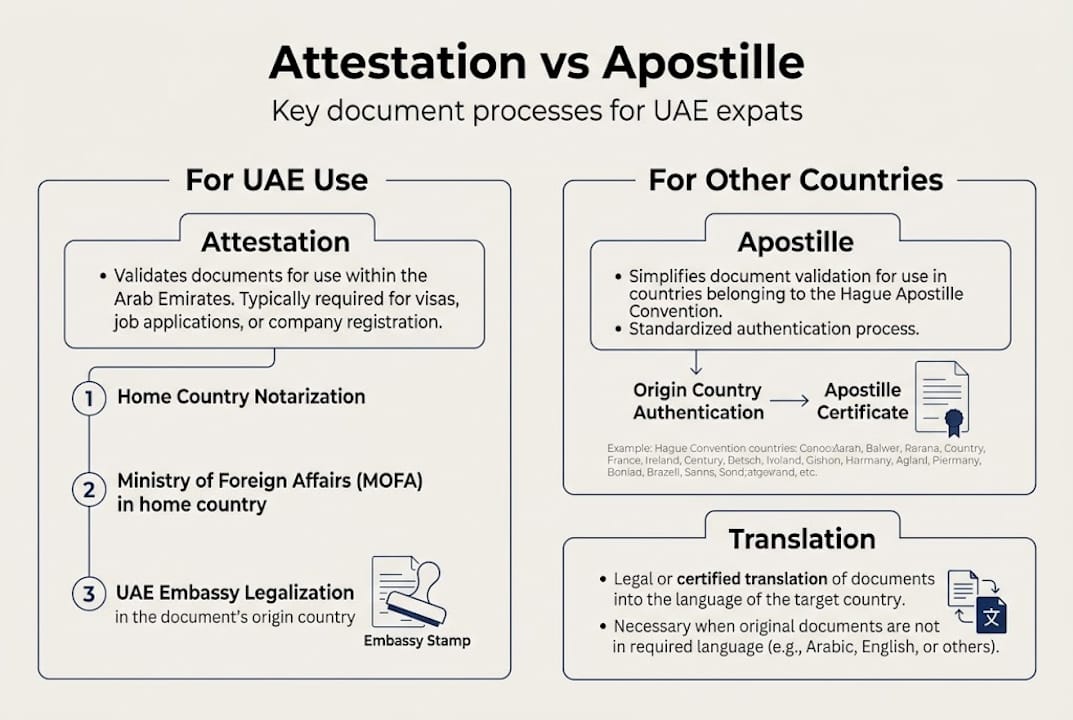
Philippine Embassy or Consulate legalization. This is the step many expats think they can skip after getting the apostille. For UAE-bound documents, you often still need the Philippine Embassy or Consulate in the UAE to legalize the document. This is because the UAE has specific bilateral requirements that go beyond the Hague Apostille Convention.
MOFA attestation in the UAE. The Ministry of Foreign Affairs and International Cooperation (MOFAIC) in the UAE is the final government stamp. This validates the document for official use across all Emirates.
Arabic translation. After MOFA attestation, most documents used for employment or legal purposes in the UAE need to be translated into Arabic by a licensed translator. This is not optional for government submissions.
Delamination and special handling. If your original document is laminated, you will need to have it delaminated before the DFA will process it. This applies to older PSA certificates and some school documents.
Pro Tip: If you are already based in the UAE and cannot travel back to the Philippines, authorized agents can handle the Philippines-side steps on your behalf, including PSA ordering, CAV processing, and DFA apostille. This is a legitimate and widely used option among OFWs and expats.
For a detailed breakdown of UAE-Philippines document attestation steps, including timelines and fee estimates, it helps to review the specific requirements for your document type before you start.
Which documents need which process? (Apostille vs. attestation vs. translation)
Not every document follows the same path. Here is a clear comparison to help you figure out exactly what your specific document needs:
Document type | CAV required | DFA apostille | Embassy/consulate legalization | MOFA attestation | Arabic translation |
PSA birth certificate | No | Yes | Yes (for UAE) | Yes | Yes |
PSA marriage certificate | No | Yes | Yes (for UAE) | Yes | Yes |
Diploma or transcript | Yes (DepEd/CHED) | Yes | Yes (for UAE) | Yes | Yes |
NBI clearance | No | Yes | Sometimes | Yes | Yes |
CENOMAR | No | Yes | Yes (for UAE) | Yes | Yes |
Barangay clearance | No | Yes | Sometimes | Yes | Yes |
A few important edge cases to know:
Older certificates issued before the PSA’s digitization program may require additional verification steps or re-issuance before they can be apostilled.
Laminated documents are a recurring problem. The DFA will not apostille a laminated document. If your PSA certificate is laminated, you need to request a fresh, unlaminated copy.
The digital eApostille introduced in 2026 is a faster option, but as noted in the complete DFA apostille guide, the eApostille is still digital and does not eliminate the need for embassy legalization when the destination country is the UAE.
Arabic translations are not just a formality. As confirmed in Philippine document authentication resources, translations to Arabic are often required post-MOFA for UAE use, particularly for employment and government submissions.
The key takeaway here is that the UAE sits outside the standard Hague Convention workflow for many document types. Even with a valid apostille, you are not done. The embassy and MOFA steps are real requirements, not optional extras. Check document processing tips for the most current requirements based on your specific situation.
New policies and common pitfalls in 2026
The attestation landscape in 2026 has shifted, and some of those changes are catching expats off guard. Here is what you need to know right now.
The eApostille rollout. The DFA’s digital eApostille system is now active and offers faster turnaround for many document types. It is a genuine improvement. However, a critical point from the DFA apostille guide is that the recent eApostille is digital but still requires embassy legalization for UAE-bound documents. Do not assume that because your apostille is digital, the process is complete.
Here is a snapshot of where most expats lose time and money in 2026:
Common mistake | Why it happens | How to avoid it |
Skipping CAV for educational docs | Not knowing it is required before DFA | Check DepEd/CHED requirements first |
Submitting laminated documents | Using old PSA copies | Request fresh, unlaminated copies |
Stopping at apostille | Assuming apostille = done for UAE | Complete embassy and MOFA steps |
Missing Arabic translation | Thinking English is accepted everywhere | Confirm translation requirements with your employer or government office |
Using expired documents | NBI clearances and some certificates expire | Check validity before starting the process |
Pro Tip: Some UAE employers and government agencies still specifically request physical embassy and MOFA stamps even when a digital apostille is available. Before you start, ask your employer or the relevant UAE authority exactly which format they accept. Getting this wrong after completing the DFA step is an expensive mistake.
The agent option is underused. Many Filipino expats in the UAE feel they cannot manage the Philippines-side steps from abroad. In reality, using an authorized agent is not just convenient, it is often the most practical solution. Agents can handle PSA ordering, CAV applications, DFA apostille appointments, and courier logistics, all without you needing to fly back. This is especially useful for urgent employment documents or family visa applications. Check filing tips for UAE expats for guidance on working with agents effectively.
The rules around attestation do shift. What was accepted last year may not be accepted in 2026. Policies at the Philippine Embassy in Abu Dhabi and Dubai, as well as MOFA requirements, are updated periodically. Always verify current requirements before submitting.
The uncomfortable truth most expats miss about document attestation
Here is something most attestation guides will not tell you directly: the biggest source of delays is not the process itself. It is the assumption that “apostille means done.”
We have seen this pattern repeatedly. An expat completes the DFA apostille, feels relieved, and submits the document to their UAE employer or a government office. Then they get a rejection notice asking for embassy legalization or an Arabic translation. At that point, they have already paid for apostille, possibly for a courier from Manila, and now they need to go back and complete steps they thought were optional.
The Philippines joined the Hague Apostille Convention, which means apostille is internationally recognized. But the UAE has its own bilateral requirements that sit on top of that. The apostille confirms the document’s origin. The embassy legalization confirms the DFA’s authority. The MOFA stamp confirms the document is valid for use in the UAE. These are three different things, and all three are often required.
Another hard truth: the process is genuinely difficult to manage from abroad without help. Many expats try to coordinate everything through relatives in the Philippines, which introduces delays, miscommunication, and the risk of incorrect steps. Reading firsthand expat stories from others who have navigated this process is one of the best ways to understand what actually happens versus what the official guides say.
Using an authorized agent is not a shortcut or a workaround. It is a legitimate, recognized option that exists precisely because the process is complex and time-sensitive. For busy expats managing work schedules in the UAE while trying to coordinate document processing in the Philippines, professional help is often the most efficient path, not the lazy one.
Finally, do not underestimate how fast the rules change. The 2026 eApostille rollout is a perfect example. It changed how apostilles are issued but did not change the UAE’s requirements for embassy and MOFA steps. Staying current matters.
Let Harris N Charms smooth your attestation journey
Navigating the full attestation chain from the UAE is genuinely complex, and the cost of getting it wrong adds up fast.
Harris N Charms specializes in exactly this: end-to-end attestation and apostille services for Filipino expats in the UAE. Whether you need help with PSA documents, CAV processing, DFA apostille, embassy legalization, MOFA attestation, or Arabic translation, the team handles each step with the current requirements in mind. You do not have to coordinate across multiple offices or worry about missing a step. If your situation involves laminated documents, older certificates, or urgent timelines, that is handled too. Ready to move forward without the guesswork? Book your attestation appointment online and get expert support from people who know this process inside and out.
Frequently asked questions
Can I get my documents apostilled while I am already in the UAE?
Yes, you can use authorized agents in the Philippines to handle the apostille process on your behalf if you are based in the UAE, so there is no need to travel back.
Does the new eApostille in 2026 mean I can skip embassy or consulate legalization?
No. For UAE use, you still often need additional legalization at the Philippine Embassy or Consulate after the eApostille, as the DFA apostille guide confirms the digital format does not replace this step.
Do all documents need translation into Arabic for UAE use?
Most official documents must be translated into Arabic after MOFA attestation, especially for employment and legal processes, as translations to Arabic are often required post-MOFA for UAE use.
What should I do if my document is laminated?
Laminated documents may need to be delaminated before apostille or attestation can proceed, so request a fresh, unlaminated copy from the PSA if possible.
Recommended
Blog | Harris N Charms Docs Website
Our services | Harris N Charms Docs Website
Home | Harris N Charms Docs Website
Accessibility Statement | Harris N Charms Docs Website
Comments