
What Is True Copy Attestation? A Clear 2026 Guide

True copy attestation is the formal confirmation by an authorized professional that a photocopy is an exact, genuine replica of the original document. For Filipino expats in the UAE, this process appears constantly across visa applications, employment contracts, and administrative filings. Notaries, attorneys, and government officials each play a role depending on the document type and jurisdiction. Getting it wrong means rejected applications and costly delays. This guide explains what true copy attestation is, who performs it, which documents qualify, and how to get it right the first time.
What is true copy attestation and why does it matter?
True copy attestation is defined as the official certification that a photocopy matches its original document exactly, confirmed by an authorized person through physical comparison. The industry term for this is a certified true copy (CTC), and the two phrases are used interchangeably across legal and government contexts. A certified true copy is a photocopy of an original document verified by an authorized professional as a genuine reproduction.
The importance of true copy attestation cannot be overstated for expats. Embassies, the UAE Ministry of Foreign Affairs, employers, and banks all require attested copies rather than originals to protect those originals from loss or damage. The process creates a legally recognized duplicate that carries the same weight as the original in most administrative and legal settings. Without it, your documents simply will not be accepted.

True copy document verification is not a validation of whether the original document is legitimate. Attestation only certifies that the copy provided exactly matches the original document shown at that moment. This distinction matters enormously when you are dealing with visa officers or legal proceedings who may ask follow-up questions about document authenticity.
How does the true copy attestation process work?
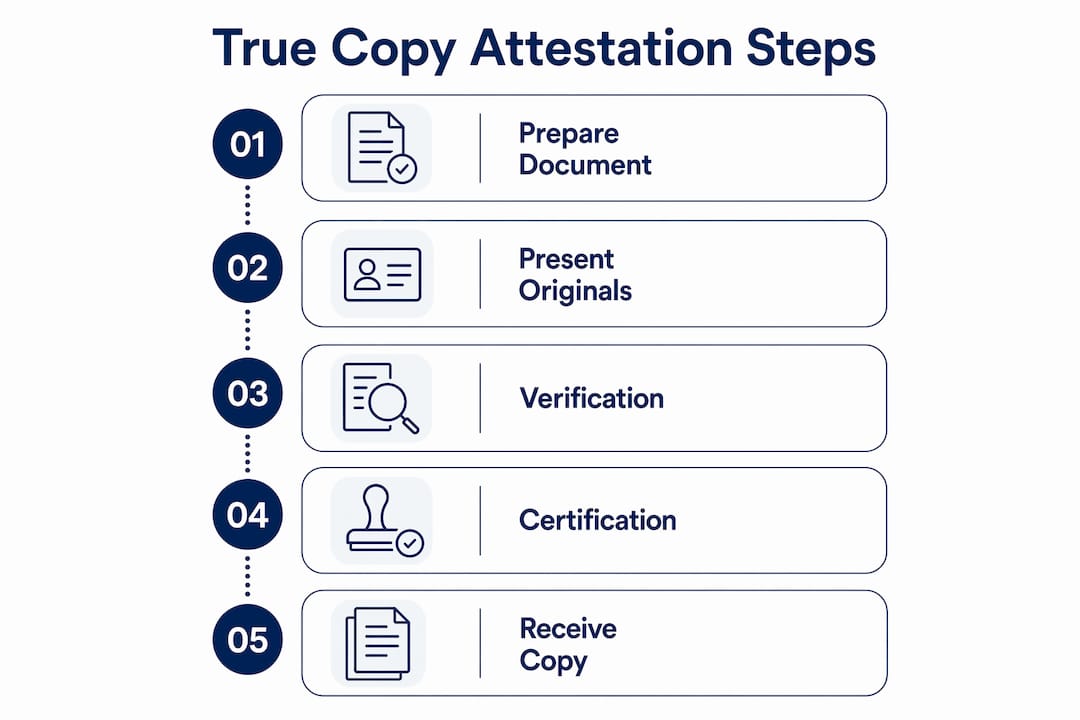
The true copy certification process follows a clear sequence, and each step is non-negotiable. Here is how it works in practice:
Present both the original and the photocopy to the authorized certifier in person. You cannot mail documents or submit them digitally for this purpose.
The certifier physically compares the copy against the original, checking every detail including signatures, stamps, and formatting.
The certifier signs a certification statement on the copy itself or on an attached page, confirming the copy is a true and accurate reproduction of the original.
The certifier applies their official seal or stamp, which identifies them as an authorized professional and gives the attestation legal standing.
You receive the attested copy, which is now valid for submission to the requesting agency.
The physical presence requirement is absolute. Without the original document’s custodian present, true copy attestation cannot be completed, which prevents remote or mail-based certifications. This rule exists specifically to prevent forgery and protect the integrity of the process.
Authorized certifiers vary by jurisdiction. Notaries public handle most private document attestations in the Philippines and the UAE. Attorneys can certify copies of legal documents they prepared or hold. Government officials certify documents within their specific authority. Copy certification laws vary significantly by jurisdiction, requiring you to verify local rules before requesting attestation.
Pro Tip: Before booking an appointment with any certifier, contact the requesting agency directly and ask which professional they recognize as an authorized certifier for your specific document type. This single step prevents the most common rejection.
What documents can and cannot be attested as true copies?
Not every document qualifies for true copy attestation by a notary or attorney. Understanding this distinction saves you from submitting the wrong certification type entirely.
Documents typically eligible for true copy attestation:
University diplomas and academic transcripts
Employment contracts and offer letters
Bank statements and financial records
Passports and national identity cards (the copy, not a new document)
Private contracts and agreements
Professional licenses and certifications
Insurance policies and property documents
Documents that cannot be attested by notaries:
Birth certificates
Marriage certificates
Death certificates
Court records and judicial decisions
Land titles and government-issued property records
Many states and jurisdictions restrict notaries from certifying copies of vital or public records. Original custodians like government agencies must certify those documents. Using a notary for a birth certificate, for example, causes automatic application rejection.
Document type | Who certifies it | Notes |
University diploma | Notary or attorney | Eligible for standard true copy attestation |
Employment contract | Notary or attorney | Eligible; must present original |
Birth certificate | Philippine Statistics Authority (PSA) | Notary cannot certify; PSA issues official copies |
Marriage certificate | PSA or local civil registry | Must come from the issuing government body |
Court records | Issuing court clerk | Certified by the court, not a notary |
Passport copy | Notary | Eligible; certifier compares copy to original passport |
For Filipino expats, this means your PSA-issued birth certificate and marriage certificate must come directly from the PSA or the Philippine Consulate. No notary in the UAE can substitute for that certification. The OFW guide to document attestation covers exactly which documents require which certification path for UAE applications.
What is the difference between true copy attestation, certified copies, and notarization?
These three terms describe related but distinct processes, and confusing them is the top cause of document rejection. Here is the breakdown:
True copy attestation confirms that a photocopy matches the original. The certifier compares the two documents and signs off on the copy’s accuracy. It says nothing about whether the original is legitimate.
Certified copies are issued by the original custodian of the document, typically a government agency or institution. When the PSA issues a copy of your birth certificate, that is a certified copy. The issuing body guarantees both the accuracy of the copy and the legitimacy of the original.
Notarization is a different process entirely. Notarization validates the signer’s identity and the signing act, not document content or copy accuracy. When you notarize a signature, the notary confirms you are who you say you are and that you signed willingly. They are not confirming anything about the document’s content.
Process | Purpose | Who performs it | What it confirms |
True copy attestation | Copy matches original | Notary, attorney, authorized official | Copy fidelity only |
Certified copy | Official duplicate | Original issuing agency | Copy fidelity and document legitimacy |
Notarization | Identity and signature verification | Notary public | Signer identity and voluntary signing |
Notaries only certify that the copy matches the original presented. They do not verify the legitimacy of the original document’s contents or authenticity. This is a critical point for anyone submitting documents to UAE immigration or employment authorities.
Pro Tip: If an agency asks for a “notarized copy,” clarify whether they mean a true copy attestation or a notarized signature on a declaration. The two are different, and the wrong one will get your application returned.
Understanding the difference between attestation and apostille is equally important when documents cross international borders, since apostilles serve a different legal function than attestation.
How to ensure your attestation meets visa and employment requirements
Getting a valid attestation accepted by UAE agencies in 2026 requires preparation before you walk into any office. Follow these steps to avoid the most common pitfalls:
Research the specific requirement first. Different agencies have different rules. The UAE Ministry of Human Resources has different standards than a private employer or a bank. Call or email before you prepare anything.
Confirm who is authorized to attest your document. Notaries often lack authority to certify certain documents depending on jurisdiction. Verify this before your appointment.
Bring the original document in perfect condition. Torn, faded, or damaged originals create problems during comparison. If your original is damaged, address that first.
Keep attestations recent. Outdated attestations for time-sensitive documents like corporate registrations are frequently rejected. Many UAE agencies require attestations dated within three to six months.
Ask for the exact wording required. Some agencies specify the language that must appear on the certification statement. Request a sample certificate or template from the agency before your appointment.
Never attest restricted documents through unauthorized channels. Submitting a notary-attested birth certificate when a PSA-certified copy is required does not just delay your application. It can flag your file for additional scrutiny.
True copy attestation is often the first step in a legalization chain for international document use. For Filipino expats in the UAE, this chain typically runs from Philippine notarization through the Department of Foreign Affairs (DFA) and then to UAE embassy authentication. Each step builds on the last, so a flaw at the attestation stage affects everything that follows.
Pro Tip: Ask the certifier to write the certification statement on the copy itself rather than on a separate attached page. Attached pages can become separated during processing, which creates doubt about which document the certification applies to.
Key takeaways
True copy attestation confirms copy accuracy only. It does not validate the original document’s legitimacy, and confusing it with notarization or certified copies causes the majority of application rejections.
Point | Details |
Definition of true copy attestation | An authorized professional confirms a photocopy exactly matches the original through physical comparison. |
Who can attest | Notaries, attorneys, or government officials depending on document type and jurisdiction. |
Vital records exception | Birth, marriage, and death certificates must be certified by the issuing agency, not a notary. |
Attestation vs. notarization | Attestation confirms copy accuracy; notarization confirms signer identity. These are not interchangeable. |
Validity window | Keep attestations recent. Many UAE agencies reject certifications older than three to six months. |
What I’ve learned from years of watching attestation go wrong
Most of the problems I see with true copy attestation come down to one thing: people assume the process is simpler than it is and skip the research step entirely. They get a document notarized, submit it, and then discover three weeks later that the agency wanted a PSA-certified copy or a specific wording on the certification statement.
The second most common mistake is treating all notaries as interchangeable. In the Philippines, a notary’s authority is tied to their commission area. In the UAE, the rules differ again. I have seen applications rejected because the certifier was technically authorized but not recognized by the specific agency receiving the document. That is a painful and avoidable outcome.
What actually works is treating attestation as a research task before it becomes a paperwork task. Find out exactly what the receiving agency accepts, then work backward to get the right certification from the right person. This approach takes more time upfront but eliminates the back-and-forth that costs weeks.
The growing interest in remote or online attestation is understandable, but the in-person comparison requirement is not going away. Any service claiming to offer fully remote true copy attestation without physical document comparison is not providing a legally valid certification. Be skeptical of shortcuts in this area.
When in doubt, work with a professional service that knows the specific requirements for your destination country. The cost of getting it right the first time is always lower than the cost of starting over.
— Harris
How Harrisncharms can help with your document attestation

Harrisncharms specializes in document attestation services for Filipino expats in the UAE, covering everything from true copy attestation to full legalization chains for visa and employment applications. The team understands the specific requirements of UAE government agencies, private employers, and financial institutions, so your documents are prepared correctly from the start. Harrisncharms stays current with 2026 attestation rules and agency-specific requirements, which means fewer rejections and faster processing. If you need guidance on which certification your document requires or want a professional to handle the process, reach out to Harrisncharms directly for reliable, compliant attestation support.
FAQ
What is true copy attestation in simple terms?
True copy attestation is an official confirmation by an authorized professional that a photocopy is an exact match of the original document. The certifier physically compares both documents and signs a statement confirming the copy’s accuracy.
Can a notary attest all types of documents?
No. Notaries cannot attest vital records like birth, marriage, or death certificates. Those must be certified by the original issuing agency, such as the Philippine Statistics Authority (PSA) for Filipino documents.
How long does true copy attestation take?
Notarized true copy attestations are typically completed the same day. Government-certified copies from agencies like the PSA can take 10 to 20 business days depending on the document and processing method.
Is true copy attestation the same as notarization?
No. True copy attestation confirms a copy matches the original. Notarization confirms the identity of a signer and the validity of a signature. The two serve different legal purposes and are not substitutes for each other.
How do I know if my attestation will be accepted by a UAE agency?
Contact the receiving agency directly before obtaining any certification and ask for their specific requirements, including who they recognize as an authorized certifier and how recent the attestation must be. The professional attestation guide for Filipino expats also outlines common UAE agency requirements in detail.
Recommended
Comments