
Apostille Processing Timeline Philippines: 2026 Guide

The apostille processing timeline in the Philippines ranges from 24 hours to 5 working days for standard cases, depending on the authentication method and document type. The Department of Foreign Affairs (DFA) handles apostille certification for documents used abroad under the Hague Apostille Convention, which the Philippines joined in 2019. The Philippine Statistics Authority (PSA) and the Commission on Higher Education (CHED) issue the underlying documents that feed into this process. Choosing between regular processing at PHP 100, expedited processing at PHP 200, or the newer electronic apostille (e-Apostille) system determines how fast your documents reach compliance for international use. Filipinos preparing documents for work, study, or residency abroad need to account for both the DFA apostille step and the time required to obtain the original documents from PSA or CHED.
What are the main apostille processing options in the Philippines?
The DFA offers three distinct paths for apostille certification, and each carries a different time frame and fee structure.
Regular processing takes 5 working days and costs PHP 100 per document. This is the standard option for most physical documents, including PSA-issued civil registry records and notarized documents. It suits applicants who are not working against a tight deadline.
Expedited processing takes 2 working days and costs PHP 200 per document. The faster turnaround makes it the practical choice for Filipinos with imminent visa appointments or employment start dates. The document types eligible for expedited processing are the same as for regular processing.
The e-Apostille system processes eligible documents within approximately 24 hours. This digital option applies to PSA-issued documents and CHED-authenticated academic records that carry electronic signatures. The result is a digitally signed apostille certificate delivered online, with no physical pickup required.
Processing type | Time frame | Fee |
Regular | 5 working days | PHP 100 |
Expedited | 2 working days | PHP 200 |
e-Apostille | ~24 hours | Varies |
Not every document qualifies for the e-Apostille route. Physical documents with a notary’s dry seal, affidavits, and documents requiring signature verification must go through the traditional DFA authentication process. Confirming eligibility before booking an appointment saves significant time.
Pro Tip: Book your DFA appointment as early as possible. Appointment slots fill up quickly, and the actual wait for a slot can add days to your total timeline before processing even begins.
How does PSA document processing affect the overall apostille timeline?
The apostille clock does not start until your source document is ready and correctly authenticated. PSA document acquisition is the step most Filipinos underestimate, and it often determines the true length of the entire process.
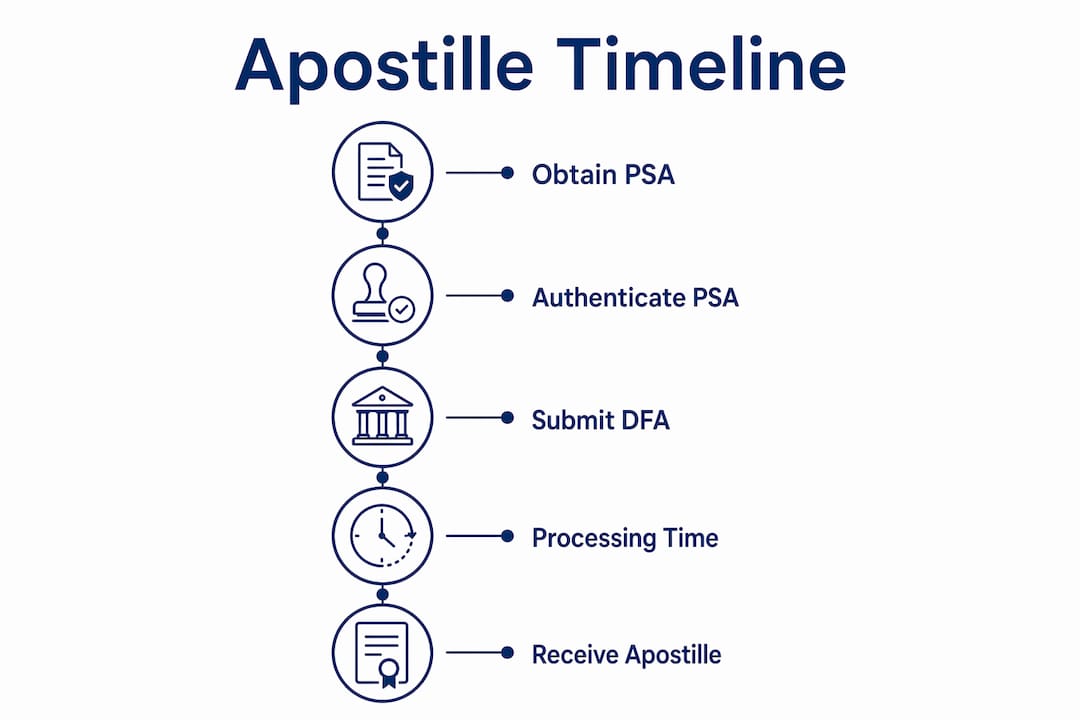
PSA issuance times vary by application method: walk-in requests take same-day to 3 working days, online orders through the PSA Serbilis portal take 3–9 working days, and requests through SM Business Centers take 7–15 working days. Choosing the walk-in method at a PSA outlet cuts the waiting period significantly compared to online or mall-based channels.
Once you have the PSA document in hand, DFA authentication adds another 3–7 working days before the apostille is applied. That means a Filipino who orders a PSA birth certificate online and then submits it for regular DFA processing could wait up to 14 working days in total. Planning around that full window prevents missed deadlines.
The most serious delay comes from archival problems. Blurred or damaged PSA records require additional verification cycles that add 30–45 days to the overall process. Late-registered births and records with clerical errors fall into this category. Filipinos with older documents or records from rural municipalities should request a PSA copy early to check for legibility issues before they become a crisis.
For a detailed breakdown of how PSA and DFA steps connect, the PSA DFA apostille guide from Harrisncharms covers the full authentication chain clearly.
What challenges affect apostille processing timelines in the Philippines?
Several factors outside the standard processing windows can extend your total wait time. Knowing them in advance lets you plan around them rather than react to them.
Appointment availability at the DFA. Applicants must secure online appointments for DFA authentication; walk-in transactions are generally not available due to high demand. During peak periods, such as the months before major overseas deployment seasons, available slots can be weeks away. The appointment wait time is separate from the official processing time and does not appear in any published time frame.
e-Apostille acceptance by destination countries. Some countries and institutions still require the traditional dry seal apostille and do not accept the digital format. The UAE, for example, has specific document authentication requirements that Filipino expats must verify before choosing the e-Apostille path. Submitting a digital apostille to an institution that requires a physical one means starting the entire process over.
Document-specific complications. Affidavits and documents requiring signature verification follow a different DFA workflow than PSA civil registry records. These documents need notarization before submission, and the notary’s credentials must be on file with the DFA. Any mismatch in the notary’s registration adds another round of corrections.
Administrative backlogs. Post-holiday periods and the months following major policy changes, such as the rollout of the e-Apostille system in 2023, tend to produce processing delays beyond the published time frames. Building a buffer of at least 5 extra working days into your planning is a practical safeguard.
Pro Tip: Before choosing between e-Apostille and traditional processing, contact the receiving institution directly and ask whether they accept digitally signed apostille certificates. One email or phone call can save you weeks.
For a complete walkthrough of the full process, the Filipino apostille process guide from Harrisncharms covers 2026 procedural updates in detail.
How do you track your apostille application status?
The DFA provides an online tracking system specifically for apostille applications. Knowing how to use it correctly prevents unnecessary trips to DFA offices and reduces anxiety during the waiting period.
Go to track.apostille.gov.ph on any browser.
Enter your processing date, slip number, and official receipt number. All three appear on the claim stub the DFA issues at the time of submission.
The system displays the current status of your application, including whether it is still in processing, ready for release, or flagged for a problem.
Check the tracker on the last day of your expected processing window, not before. The system updates in batches, and checking too early returns incomplete information.
If the status shows no update beyond the expected release date, contact the DFA office where you submitted the documents directly. Bring your official receipt number to any follow-up inquiry.
The DFA tracking website covers apostille applications submitted at all DFA consular offices nationwide. The system does not cover PSA document requests, which have a separate tracking process through the PSA Serbilis portal. Managing both trackers separately keeps your overall timeline accurate.
Legal experts note that the shift to digital apostille services has significantly reduced administrative backlogs for eligible document types. That improvement is real, but it applies only to documents that qualify for the e-Apostille system. For physical documents, the tracking and pickup process remains unchanged.
Key Takeaways
The total apostille documents processing time in the Philippines depends on both the DFA processing method and the time needed to obtain the source document from PSA or CHED.
Point | Details |
Regular vs. expedited processing | Regular takes 5 working days at PHP 100; expedited takes 2 working days at PHP 200. |
e-Apostille speed | Eligible PSA and CHED documents receive digital apostille certification within approximately 24 hours. |
PSA document timing | Walk-in PSA requests take same-day to 3 days; online orders take up to 15 working days via SM Business Centers. |
Archival delays | Blurred or damaged PSA records add 30–45 days to the total timeline. |
Verify before applying | Confirm whether the destination country or institution accepts digital apostilles before choosing the e-Apostille route. |
What I’ve learned from watching Filipinos navigate apostille timelines
The single biggest mistake I see is treating the DFA processing time as the entire timeline. Filipinos book an expedited appointment, expect their documents in 2 working days, and then realize they still need to wait for the PSA copy to arrive. The apostille step is the last step, not the only step.
The e-Apostille rollout has genuinely changed things for the better. For PSA-issued birth certificates and CHED-authenticated diplomas, the 24-hour turnaround is real and consistent. Verifying recipient requirements for electronic versus physical apostilles before applying is the one step that separates people who finish the process smoothly from those who repeat it. I have seen Filipino expats in the UAE submit a digital apostille to an employer who required a physical dry seal copy, and the cost was not just time. It was a delayed visa and a rescheduled flight.
My consistent advice: start the PSA document request the moment you know you need an apostille. Do not wait until you have your DFA appointment confirmed. The two processes run in parallel, and overlapping them cuts your total wait time significantly. If your document is older than 20 years or from a rural municipality, request it even earlier and inspect it for legibility before you do anything else.
— Harris
Harrisncharms can help you get this right the first time
Navigating the apostille application timeline in the Philippines takes more than knowing the published time frames. It requires coordinating PSA requests, DFA appointments, and destination-country requirements at the same time.

Harrisncharms specializes in document attestation services for Filipino expats in the UAE, guiding clients through every step from PSA document acquisition to DFA apostille submission. The team handles appointment scheduling, document review, and compliance checks so you avoid the repeat trips and missed deadlines that slow most applicants down. Whether you need a single birth certificate apostilled or a full set of employment documents authenticated, Harrisncharms provides clear timelines and direct support from start to finish. Reach out through the Harrisncharms website to get started.
FAQ
How long does the apostille process take in the Philippines?
The DFA apostille takes 2–5 working days depending on whether you choose expedited or regular processing. The e-Apostille option for eligible PSA and CHED documents is issued within approximately 24 hours.
What documents can use the e-Apostille system?
PSA-issued civil registry documents and CHED-authenticated academic records with electronic signatures qualify for the e-Apostille. Physical documents with notary dry seals must go through traditional DFA authentication.
How do I check my apostille application status?
Use the DFA’s official tracking site at track.apostille.gov.ph. You will need your processing date, slip number, and official receipt number to retrieve your application status.
Does the UAE accept Philippine e-Apostille documents?
Acceptance of digital apostilles varies by institution and document type. Filipino expats heading to the UAE should confirm with their employer, school, or government authority whether a physical dry seal apostille is required before applying.
What causes the longest delays in the Philippines apostille process?
Damaged or unreadable PSA records are the most serious delay factor, adding 30–45 days for archival verification. Appointment unavailability at the DFA and missing notary credentials are the next most common causes of extended wait times.
Recommended
Comments