
What Is Secondary Attestation? A Clear Guide

Secondary attestation is the layered process of verifying a document’s authenticity through multiple official endorsements to make it legally acceptable abroad. The term itself is not a formal legal concept. It describes what legal professionals call multi-step document legalization, a sequence of verifications involving notaries, government ministries, and foreign embassies. If you are a Filipino expat in the UAE preparing employment contracts, academic transcripts, or powers of attorney, understanding this process is the difference between documents that get accepted and documents that get rejected.
What does secondary attestation mean in document legalization?
Secondary attestation, in practical terms, refers to the multi-step legalization process that includes apostille certification or consular legalization for international document use. The phrase “secondary” is informal. It has no standing in legal codes or international treaties. People use it to describe the verification steps that come after the initial signing or notarization of a document.

The standard industry term for this process is document legalization or consular legalization. Both terms describe the same chain of official endorsements that foreign governments require before they recognize a document as genuine.
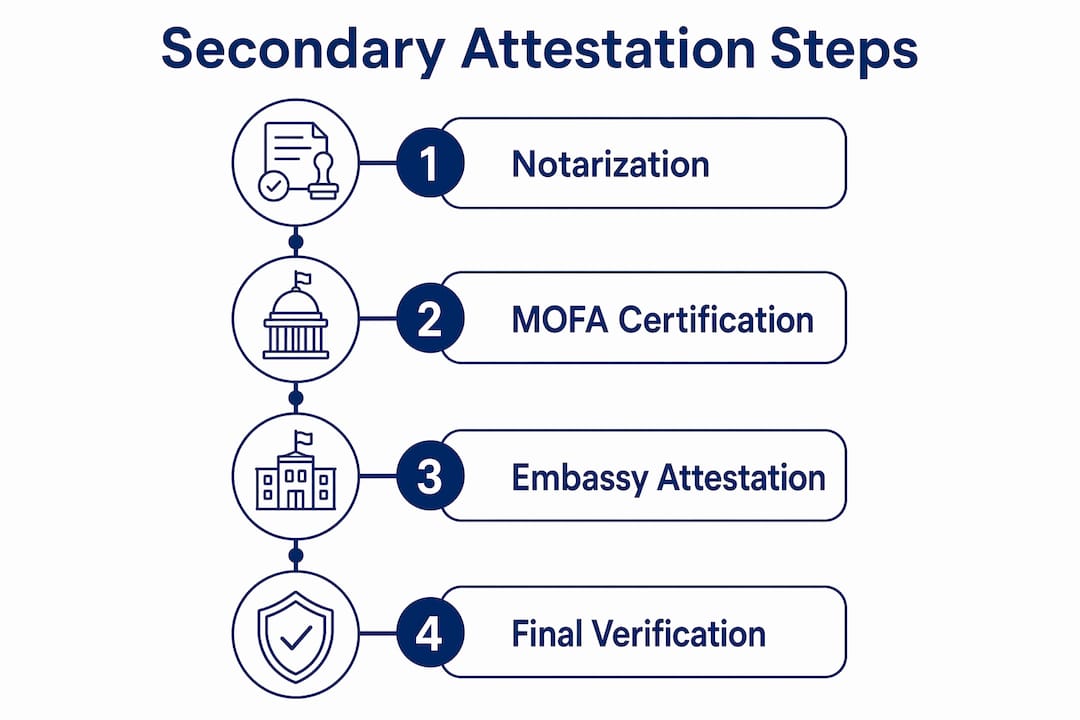
Here is how the typical legalization chain works:
Notarization. A licensed notary public verifies the identity of the signer and affixes an official seal. This is the first link in the chain.
Ministry of Foreign Affairs (MOFA) verification. The relevant government ministry of the document’s country of origin authenticates the notary’s seal and signature.
Embassy or consulate attestation. The destination country’s embassy or consulate confirms the MOFA’s seal, making the document valid for use in that country.
Each step authenticates the prior signatory’s authority and is mandatory regardless of how it is labeled. Skipping any single step renders the entire document invalid for foreign use. Legal professionals are clear on this point: no step in this chain is truly “secondary” in importance.
Pro Tip: Ask the receiving authority in your destination country for a written checklist of every required stamp and seal before you start the process. This prevents costly restarts.
How does secondary attestation differ from notarization and legalization?
Confusion around this topic is widespread. Experts note that the word “attestation” carries two different meanings depending on context, and that gap causes real problems for people preparing documents.
Here is a clear breakdown of the key terms:
Term | Who Performs It | What It Does |
Attestation | A witness (non-notary) | Confirms a signature was made voluntarily in their presence |
Notarization | A licensed notary public | Verifies signer identity, adds official seal and signature |
MOFA Legalization | Ministry of Foreign Affairs | Authenticates the notary’s credentials for international use |
Embassy/Consulate Attestation | Destination country’s mission | Confirms MOFA seal; grants foreign legal recognition |
Apostille | Competent authority (Hague member) | Replaces embassy step for countries in the Hague Convention |
Wills and powers of attorney typically require attesting witnesses. Affidavits and contracts often require notarization, and sometimes both. The distinction between attestation and notarization matters because submitting a document with only one when both are required will result in rejection.
The apostille deserves special attention. Countries that belong to the Hague Apostille Convention accept a single apostille certificate in place of the full embassy legalization chain. Countries outside the convention require the complete sequence: notary, MOFA, then embassy. Knowing which category your destination country falls into saves significant time and money.
Pro Tip: When contacting a government office or embassy, use the phrase “document legalization requirements” rather than “secondary attestation.” Precise terminology gets you faster, more accurate answers.
What are real examples of the secondary attestation process?
The process looks different depending on the document type and the destination country. These examples show how the steps apply in practice.
Higher secondary transcripts. Academic records require multiple government validations before a foreign university or employer will accept them. In the Philippines, this typically means authentication by the Department of Foreign Affairs (DFA), followed by attestation at the UAE embassy.
Employment contracts. A contract signed in the Philippines for a job in the UAE must be notarized, authenticated by the DFA, and then attested by the UAE embassy in Manila before it carries legal weight in the UAE.
Powers of attorney. These documents authorize someone to act on your behalf in legal or financial matters. They require notarization and full legalization before any foreign court or institution will recognize them.
Hague Convention members vs. non-members. The Philippines is not a member of the Hague Apostille Convention. This means Filipino documents destined for the UAE cannot use the simplified apostille route. They require the full consular legalization sequence, which involves 2–4 verification steps across different government bodies.
Destination-specific variations. Some countries require additional steps, such as translation by a certified translator before MOFA submission, or chamber of commerce certification for commercial documents. Always verify the exact requirements for your specific destination.
The role of consular authorities in this chain is not ceremonial. Each embassy or consulate applies its own country’s standards when deciding whether to recognize a foreign document, which is why their final attestation carries legal weight.
How do you avoid common mistakes in the attestation process?
Most document rejections abroad are preventable. They happen because of terminology confusion, missed steps, or incorrect sequencing. Here is what to watch for:
Skipping steps. Incomplete legalization invalidates documents for foreign legal proceedings. Every stamp and seal in the chain must be present.
Wrong order. The sequence is fixed: notary first, then MOFA, then embassy. Submitting to the embassy before MOFA authentication is a common error that forces the entire process to restart.
Using unverified notaries. Not all notaries are authorized for documents intended for international use. Verify that your notary is licensed and recognized by the relevant government authority.
Ignoring document-specific requirements. Academic records, employment contracts, and personal documents each have different requirements. A process that works for one document type may not apply to another.
Failing to check embassy processing times. Embassy attestation timelines vary widely. Some take days; others take weeks. Build this into your planning, especially if you have a visa or employment start date.
Pro Tip: Always request at least two certified copies of every document before starting the legalization process. If one copy gets lost or rejected at any stage, you have a backup ready without returning to the original issuing authority.
Harrisncharms works with Filipino expats in the UAE daily and sees these errors repeatedly. The most consistent pattern is people arriving with documents that are notarized but not MOFA-authenticated, assuming the embassy will accept them. They will not. Understanding why attestation services matter for your specific situation is the first step toward getting it right.
Key takeaways
Secondary attestation describes the full multi-step document legalization chain, and every step in that chain carries equal legal weight for international acceptance.
Point | Details |
Not a formal legal term | “Secondary attestation” is informal; the correct term is document legalization or consular legalization. |
Three-step chain | The standard sequence is notarization, MOFA verification, then embassy or consulate attestation. |
No step is optional | Skipping any single step invalidates the document for foreign use, regardless of how minor it seems. |
Apostille vs. full legalization | Hague Convention members use apostille; non-members like the Philippines require the full consular chain. |
Document type matters | Academic transcripts, employment contracts, and powers of attorney each follow slightly different requirements. |
Why most people get this wrong before they even start
I have seen hundreds of cases where someone arrived with a stack of documents, confident everything was in order, only to discover a critical step was missing. The frustration is real. But in almost every case, the root cause was the same: they searched for “secondary attestation,” got a vague or conflicting answer, and proceeded without confirming the exact requirements for their specific document and destination.
The term “secondary attestation” is genuinely misleading. It implies some steps matter more than others. They do not. The notary seal, the MOFA stamp, and the embassy attestation are each load-bearing parts of the same structure. Remove one and the whole thing fails.
What I tell people is this: stop thinking about the process as primary and secondary. Think of it as a chain. Every link must hold. If you are preparing documents for the UAE as a Filipino expat, the document legalization process has a specific sequence that does not bend for convenience or tight timelines.
Technology is slowly changing parts of this. Some countries are moving toward digital apostilles and electronic verification. But for most Filipino expats dealing with the UAE today, the physical stamp-and-seal chain remains the standard. Plan for it, not around it.
— Harris
Get your documents legalized without the guesswork
Harrisncharms specializes in document attestation and legalization for Filipino expats in the UAE. Whether you need your academic transcripts authenticated, your employment contract attested, or your personal documents prepared for legal use abroad, the team handles the full verification chain on your behalf.

Harrisncharms manages every step from notarization coordination to MOFA submission and UAE embassy attestation, so nothing gets missed and nothing gets out of order. The team also tracks your documents through each stage and keeps you informed throughout. If you are unsure which steps your specific document requires, reach out for a direct consultation through Harrisncharms and get a clear answer before you start.
FAQ
What is secondary attestation in simple terms?
Secondary attestation is an informal term for the multi-step document legalization process. It involves sequential verifications by a notary, a government ministry, and a foreign embassy to make a document legally valid abroad.
Is secondary attestation the same as apostille?
No. An apostille is a simplified certification used between Hague Apostille Convention member countries. Secondary attestation, or full consular legalization, is required for countries outside the convention, such as the UAE for documents from the Philippines.
What documents typically require secondary attestation?
Academic transcripts, employment contracts, powers of attorney, and personal documents like birth certificates commonly require full legalization for international use. Each document type may have slightly different requirements depending on the destination country.
What happens if you skip a step in the attestation process?
Incomplete legalization renders documents void for foreign legal proceedings. Every official stamp and seal in the sequence must be present for the document to be accepted abroad.
How long does the secondary attestation process take?
Timelines vary by document type, country of origin, and destination. The full chain, from notarization through embassy attestation, can take anywhere from a few days to several weeks depending on embassy processing schedules and document complexity.
Recommended
Comments