
Bonafide Certificate Attestation: What You Need to Know

Bonafide certificate attestation is a mandatory multi-stage legal verification process that confirms your bonafide certificate is authentic and officially valid for international or administrative use. The process moves through notarization, state-level verification by the HRD or Home Department, authentication by India’s Ministry of External Affairs (MEA), and final embassy or apostille legalization depending on your destination country. Without this chain of approvals, foreign universities, employers, and embassies will not recognize your document as legally binding.
What is bonafide certificate attestation and why does it matter?
A bonafide certificate is an official document issued by a school, college, university, or employer that confirms your association with that institution. It typically states your full name, date of birth, course or job designation, and the duration of your enrollment or employment. The document carries the official seal and authorized signature of the issuing body, making it genuine in the eyes of that institution.

The problem is that “genuine” is not the same as “officially valid” in another country. Attestation transforms a certificate from being merely recognized by the issuing institute to being legally accepted by foreign governments. A foreign embassy or university does not know your college registrar or your HR department. They need a chain of government-backed signatures to trust that the document is real.
A bonafide certificate typically contains the following information:
Full legal name of the certificate holder
Date of birth and identification details
Name of the issuing institution or employer
Course name, designation, or department
Duration of association (enrollment or employment period)
Official seal and authorized signature
Pro Tip: Always request the bonafide certificate on official letterhead with a fresh signature and seal. Photocopied or scanned originals are routinely rejected at the notary stage, which delays the entire process.
How does the bonafide certificate attestation process work?
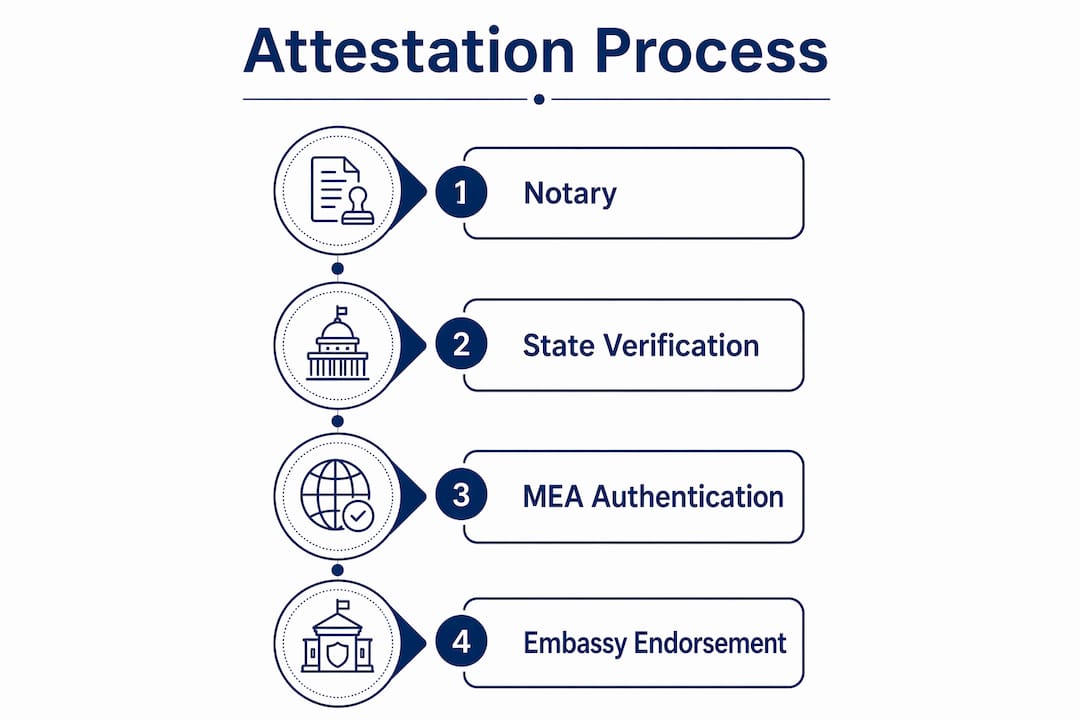
The attestation process involves four stages: notarization, state-level verification, MEA authentication, and embassy or apostille legalization. Each stage builds on the previous one, so skipping or incorrectly completing any step stops the entire chain.
Here is how the process works from start to finish:
Notary attestation. A licensed notary public verifies that the document is genuine and affixes their seal and signature. Notary attestation is the gateway that enables central government acceptance for further legalization. Without it, state authorities will not process your document.
State-level verification. This step depends on the type of bonafide certificate you hold. Educational certificates go through the Human Resource Development (HRD) department of the relevant state. Employment bonafide certificates go through the Home Department or a Sub-Divisional Magistrate (SDM). Routing through HRD or Home Department must match the certificate type. Confusing these two paths is the most common reason for MEA rejection.
MEA authentication or apostille. The Ministry of External Affairs in New Delhi applies either an authentication stamp or an apostille sticker. If your destination country is a member of the Hague Convention, the MEA apostille is sufficient and no further embassy legalization is needed. Countries like the USA, UK, Netherlands, Spain, and France fall into this category.
Embassy or consulate attestation. If your destination country is not a Hague Convention member, you must submit the MEA-authenticated document to that country’s embassy or consulate in India. The UAE, for example, requires this final embassy step. The embassy reviews the MEA stamp and applies its own seal, completing the legalization chain.
Stage | Authority | Required for |
Notary attestation | Licensed notary public | All countries |
State verification | HRD (education) or Home Dept (employment) | All countries |
MEA authentication or apostille | Ministry of External Affairs | All countries |
Embassy attestation | Destination country’s embassy | Non-Hague countries only |
Pro Tip: If you are a Filipino expat in the UAE, your bonafide certificate from the Philippines follows a similar multi-stage path through Philippine government authorities before UAE embassy legalization. Understanding attestation vs apostille differences saves you from submitting the wrong type of legalization for the UAE, which is not a Hague member.
Why is bonafide certificate attestation important for international use?
Individuals need bonafide certificate attestation primarily for long-term international purposes: student visas, work permits, and migration applications. A foreign institution or government authority will not process your application based on an unattested document, regardless of how official it looks on the surface.
The practical importance of attestation covers several areas:
Visa and admission approvals. Universities and immigration authorities require attested documents to confirm that your academic or employment history is legitimate before granting entry.
Employment verification. Employers in countries like the UAE, Saudi Arabia, and Qatar require attested bonafide certificates as part of their onboarding compliance process.
Fraud prevention. The multi-level signature chain prevents fraudulent educational and employment credential misuse. Each government authority in the chain independently verifies the document before adding its seal.
Legal standing. An attested document carries legal weight in foreign courts and administrative proceedings. An unattested one does not.
A bonafide certificate without attestation is like a contract without a witness. It may be genuine, but no external authority is obligated to honor it.
One detail many applicants overlook is the validity window. A bonafide certificate typically carries a validity of about 3 months from the date of issuance. If your attestation process runs long and the certificate expires mid-process, the entire application may be rejected. This makes timing a critical factor, not an afterthought.
For Filipino expats specifically, attested bonafide certificates are often required alongside diploma attestation when applying for UAE residency or employment visa upgrades.
What are the common challenges in bonafide certificate attestation?
Most delays and rejections in the attestation process come from a small set of predictable mistakes. Knowing them in advance puts you well ahead of the average applicant.
The most frequent errors include:
Wrong verification route. Sending an employment bonafide certificate through the HRD channel instead of the Home Department is a direct path to rejection at the MEA stage. The document type must match the state authority.
Skipping notarization. Some applicants assume that an official institutional seal is enough to proceed to state-level verification. It is not. Improper or skipped notarization stalls the entire legalization chain.
Expired certificates. Initiating attestation weeks after receiving your bonafide certificate is a common mistake. Certificate validity is limited, and delays push documents past their usable date.
Skipping embassy attestation for non-Hague countries. Applicants heading to the UAE, Qatar, or Kuwait sometimes stop at the MEA apostille stage, not realizing those countries require the additional embassy step.
Incomplete or incorrect document details. A mismatch between your name on the bonafide certificate and your passport triggers rejection at every stage. Check all personal details before initiating the process.
Pro Tip: Start the attestation process the same week you receive your bonafide certificate. The 3-month validity window moves faster than most people expect, especially when state-level verification queues are long.
How to apply for bonafide certificate attestation
Getting your bonafide certificate attested requires organized preparation before you approach any government authority. Here is a practical step-by-step guide:
Obtain the original certificate. Request the bonafide certificate directly from your institution or employer. Confirm it carries a fresh signature, official seal, and the correct personal details matching your passport.
Gather supporting documents. You will typically need your original bonafide certificate, a copy of your passport (bio-data page), passport-sized photographs, a completed application form for each authority, and photocopies of all documents.
Get notarization. Visit a licensed notary public in your city. The notary verifies the document and applies their seal. This step is non-negotiable and must come before any government submission.
Submit to the appropriate state authority. Take the notarized document to the HRD department (for educational certificates) or the Home Department/SDM office (for employment certificates) in the state where the issuing institution is located.
Submit to the MEA. Once state verification is complete, submit the document to the Ministry of External Affairs in New Delhi for apostille or authentication. MEA processing times vary by season and document volume.
Complete embassy attestation if required. For non-Hague countries like the UAE, submit the MEA-stamped document to the relevant embassy or consulate. Review the UAE attestation requirements specific to your document type before submitting.
Use an authorized attestation agency if needed. Authorized agencies handle submissions on your behalf, track document status, and know the specific requirements of each authority. This is particularly useful for expats managing the process from abroad.
Document required | Purpose |
Original bonafide certificate | Primary document for attestation |
Passport copy (bio-data page) | Identity verification at each stage |
Passport-sized photographs | Required by some state authorities |
Application forms | Submission to HRD, Home Dept, MEA, embassy |
Photocopies of all documents | Retained by each authority as records |
Key takeaways
Bonafide certificate attestation requires completing four sequential government-verified stages to transform a locally issued document into one that foreign authorities legally recognize and accept.
Point | Details |
Four-stage process | Notarization, state verification, MEA authentication, and embassy attestation must all be completed in order. |
Route matches document type | Educational certificates go through HRD; employment certificates go through the Home Department or SDM. |
3-month validity window | Start attestation immediately after receiving your certificate to avoid expiry-related rejection. |
Hague vs. non-Hague countries | Hague member countries accept MEA apostille; non-Hague countries like the UAE require additional embassy attestation. |
Notarization is non-negotiable | Skipping or incorrectly completing notarization stops the entire legalization chain at the first step. |
Why I think most people underestimate the attestation timeline
Most applicants I have worked with treat bonafide certificate attestation as a one-week task. It rarely is. State-level HRD offices in particular can take two to four weeks during peak seasons, and that is before the MEA queue. By the time some applicants reach the embassy stage, their certificate is already approaching its 3-month validity limit.
The other thing I have seen repeatedly is the routing mistake. Someone submits an employment bonafide certificate through the HRD channel because they assume all certificates follow the same path. The MEA rejects it. They restart from the state level. That single error costs three to six weeks. The fix is simple: confirm your document type before you submit anything to a state authority.
My honest advice is to treat attestation as a project with a deadline, not an errand. Map out each stage, confirm the requirements for your specific destination country, and start the moment you have the original certificate in hand. If you are managing this process from the UAE while your documents are in the Philippines or India, working with an authorized agency is not a luxury. It is the practical choice.
— Harris
Get your bonafide certificate attested without the guesswork
Harrisncharms handles the full bonafide certificate attestation process for Filipino expats in the UAE, from notarization coordination to final embassy legalization. You do not need to track down each authority or decode which verification route applies to your document type.

Harrisncharms manages every stage on your behalf, including state-level verification, MEA authentication, and UAE embassy attestation. Whether you need a single document legalized or a full set of papers for a visa or employment application, the team at Harrisncharms knows the exact requirements and handles submissions correctly the first time. Reach out to start your attestation request today.
FAQ
What is bonafide certificate attestation?
Bonafide certificate attestation is a legal verification process that confirms a bonafide certificate is authentic and officially valid for use in foreign countries or official proceedings. It involves notarization, state-level verification, MEA authentication, and embassy attestation or apostille depending on the destination country.
How long does bonafide certificate attestation take?
The full process typically takes two to six weeks depending on the state authority’s processing time and the destination country’s embassy requirements. Starting immediately after receiving your certificate is critical because the document is only valid for about 3 months from issuance.
Do I need embassy attestation or apostille for the UAE?
The UAE is not a Hague Convention member, so MEA apostille alone is not sufficient. You need the full attestation chain including final UAE embassy attestation after MEA authentication. Review the UAE document requirements before submitting.
What documents are needed for bonafide attestation?
You need the original bonafide certificate, a passport copy, passport-sized photographs, completed application forms for each authority, and photocopies of all documents. Requirements can vary slightly by state authority and destination country.
What happens if my bonafide certificate expires during attestation?
If your certificate passes its 3-month validity window before the process is complete, authorities will reject it and you will need to obtain a fresh certificate from your institution or employer and restart the process from notarization.
Recommended
Comments