
Filipinos in UAE: Four Steps to Attest a Death Certificate
Updated: 7 days ago
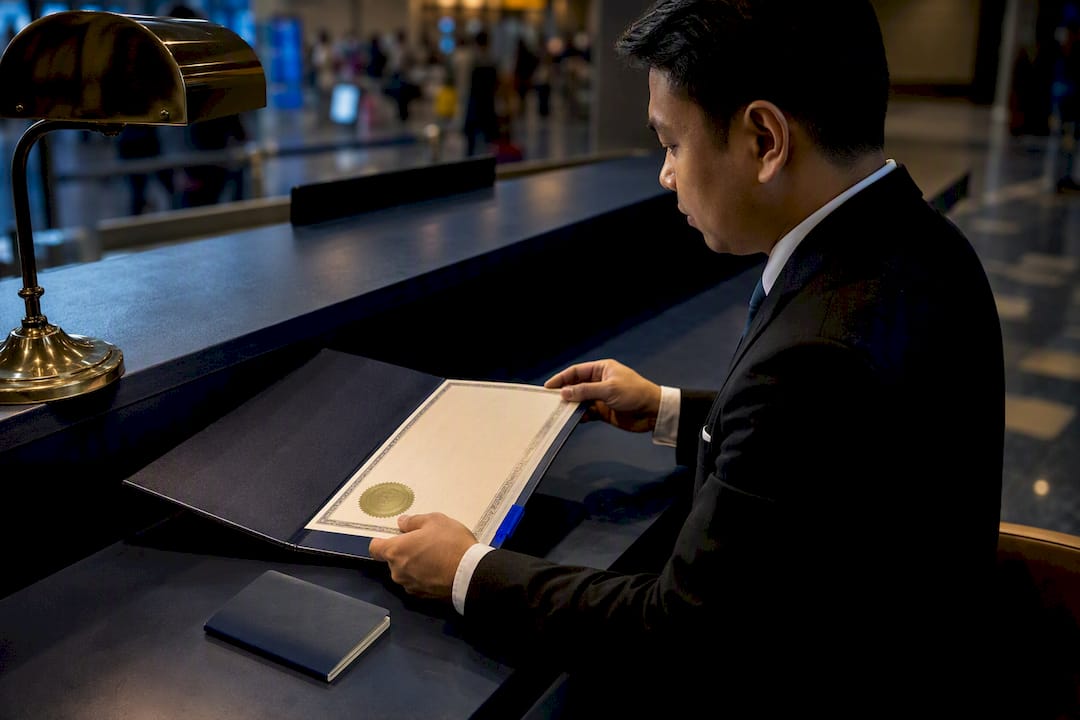
A Philippine death certificate becomes valid for UAE use only after it clears four stages in order: a PSA-issued original, a DFA apostille, legalization by the UAE Embassy in Manila, and final attestation by the UAE MOFA. Skip a step or do them out of sequence and MOFA will reject the file. Total processing usually runs one to five weeks depending on where you start, and an authorized representative can legally handle the Philippine-side steps if you can’t fly home.
TL;DR:
The Philippine death certificate must be an original issued by PSA, printed on security paper with a QR code, and cannot be a photocopy or notarized copy.
The process requires sequential legalization steps: PSA issuance, DFA apostille, UAE Embassy in Manila legalization, and UAE MOFA attestation, completed in that order.
Processing times vary from one to five weeks, with each stage needing careful verification of document authenticity and correct format to avoid rejection.
A certified Arabic translation is sometimes required but often not, so confirmation with the receiving UAE entity is necessary before arranging translation.
Using a specialized service can simplify the process by managing document collection, appointments, courier logistics, and translation, especially for expats from Dubai or Abu Dhabi.
Table of Contents for Death Certificate Attestation
Step 1: Get the Correct PSA Death Certificate First
Every stage after this one depends on getting this document right the first time. UAE authorities, and every office before them, only accept a death certificate issued by the Philippine Statistics Authority, not a photocopy, not a notarized photocopy, and not a plain printout from a local civil registrar unless that copy is specifically confirmed acceptable by the receiving UAE office.
You can order a PSA copy two ways: through PSA Serbilis for walk-in or online requests, or through the Local Civil Registrar (LCR) where the death was recorded. Domestic delivery typically takes a few business days to two weeks; if you’re already in the UAE and ordering through a representative back home, build in extra time for courier transit.
The real acceptance trigger is physical, not just legal. PSA copies print on security paper with a visible watermark and a scannable QR code, and both DFA and MOFA staff check for them. A notarized photocopy might look official, but it carries none of these features and gets bounced at the apostille counter almost every time.
Before you move to Step 2, run through this quick check:
Confirm the paper feels like security stock, not standard printer paper.
Scan or photograph the QR code to verify it resolves correctly.
Check that the deceased’s name matches spelling across all related documents (passport, marriage certificate, insurance forms).
Order at least two or three original copies. You’ll need spares if any single office keeps one.
Pro Tip: Order your PSA copies as early as possible, even before you know your full UAE processing timeline. A fresh, error-free original saves you weeks later if MOFA questions a scan quality issue or a name mismatch.
Step 2: Secure the DFA Apostille for International Use
Once you have a clean PSA original, the next move is the Department of Foreign Affairs apostille. This is the Philippine government’s authentication that tells any receiving country the document is genuine and issued by a legitimate Philippine agency. Since the Philippines joined the Apostille Convention, this single certification replaced the old “red ribbon” system for documents heading to member countries, and the UAE accepts apostilled Philippine documents under this framework.
Book your DFA apostille appointment through the DFA’s e-Apostille or e-appointment system rather than showing up unannounced. You’ll typically need:
The original PSA death certificate
A valid government-issued ID
Proof of payment for the apostille fee
A completed application form
Processing runs on two tracks: regular, which usually takes a few business days, and express, which costs more but clears faster, useful if your UAE deadline is tight. If you’re not in the Philippines, an authorized representative can submit on your behalf with a signed authorization letter and a copy of your passport or valid ID. Plan this step first if you’re coordinating from Dubai, Abu Dhabi, or Sharjah, since it’s the one stage that almost always requires someone physically present in the Philippines.
Step 3: UAE Embassy Legalization in Manila
An apostille alone doesn’t finish the job. The UAE Embassy in Manila still reviews and stamps the document according to its own mission rules before it’s accepted for UAE MOFA processing. This is a separate check from the DFA apostille, and mission FAQs specifically instruct applicants to complete DFA authentication first.
You have two practical routes here: submit in person at the embassy or through an approved courier or facilitation service that handles embassy filings regularly. Commonly requested items include the apostilled original, a photocopy of the applicant’s passport, and, if someone else is filing for you, a notarized authorization letter.
Processing windows vary, but the embassy lists a flat authentication fee of 150.00 for many certificate types, death certificates included. A few tips that save real headaches:
Track your submission with a reference number if the embassy or courier offers one.
Arrange secure courier pickup in advance if the document needs to travel back to the UAE afterward.
Keep a scanned copy of every stamped page before it moves to the next stage.
Step 4: UAE MOFA Attestation, the Final Seal
This is the stage that actually makes your death certificate usable inside the UAE. UAE MOFA offers three submission paths for the final attestation: uploading through its online portal or mobile app, arranging courier service, or booking an appointment at a MOFA Happiness Center.
The process, in order:
Register on the MOFA portal or app and create your service request.
Upload scans of the PSA original, DFA apostille, and embassy legalization stamp, or hand over the physical documents via courier or appointment.
Pay the attestation fee and wait for processing.
Receive the attested document with the MOFA stamp, either digitally or physically depending on your chosen method.
Standard MOFA processing typically takes a few days, which is fast compared to the Philippine-side steps that came before it. Fees for certificates, including death certificates, commonly appear at mission-linked fee levels, though you should always confirm the current amount directly with MOFA before paying anyone.
Employers, insurers, and courts checking your document will look specifically for the MOFA stamp or its digital verification record; it’s the mark that tells them every prior step was completed correctly. If MOFA rejects your submission, the usual fixes are reissuing a fresh PSA copy, redoing the DFA apostille if it was flawed, or getting the embassy to re-verify a smudged or unclear stamp.
Do You Need an Arabic Translation Too?
Not always. Many UAE employers and government offices accept English-language Philippine death certificates without issue, since English is widely used in UAE administrative processing. Some institutions, particularly courts or certain insurance underwriters, specifically request an Arabic translation before they’ll process a claim or filing.
Confirm the exact language requirement with the receiving UAE entity before paying for translation.
Use a translator authorized or recognized for legal document translation, not a casual bilingual service.
Translations should carry the translator’s signature, stamp, and certification statement.
Bind translation pages to the original packet rather than submitting loose sheets; MOFA reviewers want a single, clearly labeled set.
Pro Tip: Certified translation in the UAE usually takes a few business days and costs vary by provider and document length, so ask for a quote and turnaround time upfront rather than assuming a flat rate.
Common Rejection Reasons and a Stage-by-Stage Checklist
Most rejections trace back to a handful of avoidable mistakes: submitting a non-PSA copy, a document showing signs of tampering or poor print quality, a mismatched name across supporting documents, an outdated certificate that needs reissuance, or moving to the embassy stage without a completed DFA apostille.
Run through this before submitting at each stage:
PSA stage: original on security paper, QR code intact, spelling matches across documents.
DFA stage: original PSA copy, valid ID, payment proof, application form, extra copies on hand.
Embassy stage: apostilled original, passport copy, authorization letter if using a representative.
MOFA stage: all prior stamps intact and visible, translation bound and labeled if required.
If something gets refused, don’t panic. The correct order matters more than the speed you move through it:
Identify which stage flagged the issue.
Reissue the PSA copy if it’s the source problem.
Redo the DFA apostille if authentication was incomplete.
Follow up directly with the embassy for a re-verification if the stamp itself is the concern.
Keep digital scans of every stamped page and hold onto courier tracking receipts. They’re often the fastest way to prove a document is genuinely in transit rather than lost.
What a Specialized Attestation Service Actually Handles for You
A specialized attestation service typically manages the parts that eat the most time: collecting your PSA original, booking DFA and embassy appointments, coordinating courier logistics between Manila and the UAE, and arranging certified translation when a receiving office requires it.
What you still have to provide doesn’t change: your original PSA death certificate, a valid passport copy, and a signed authorization letter if you’re not physically present in the Philippines to sign for yourself. No service can substitute for those.
Some specialized services work specifically with Filipino expats navigating this exact chain, from Manila paperwork through the UAE MOFA attestation, which matters most when managing this process from Dubai or Abu Dhabi while grieving and working full time.
— Harris
How Harris N Charms Can Help With Your Attestation
A specialized attestation service can be a practical alternative to running this four-stage process solo from a UAE office desk. Coordinating document pickup, DFA apostille filing, embassy legalization, MOFA upload, and certified translation from thousands of miles away eats vacation days and invites costly mistakes, one missing stamp and you start over.

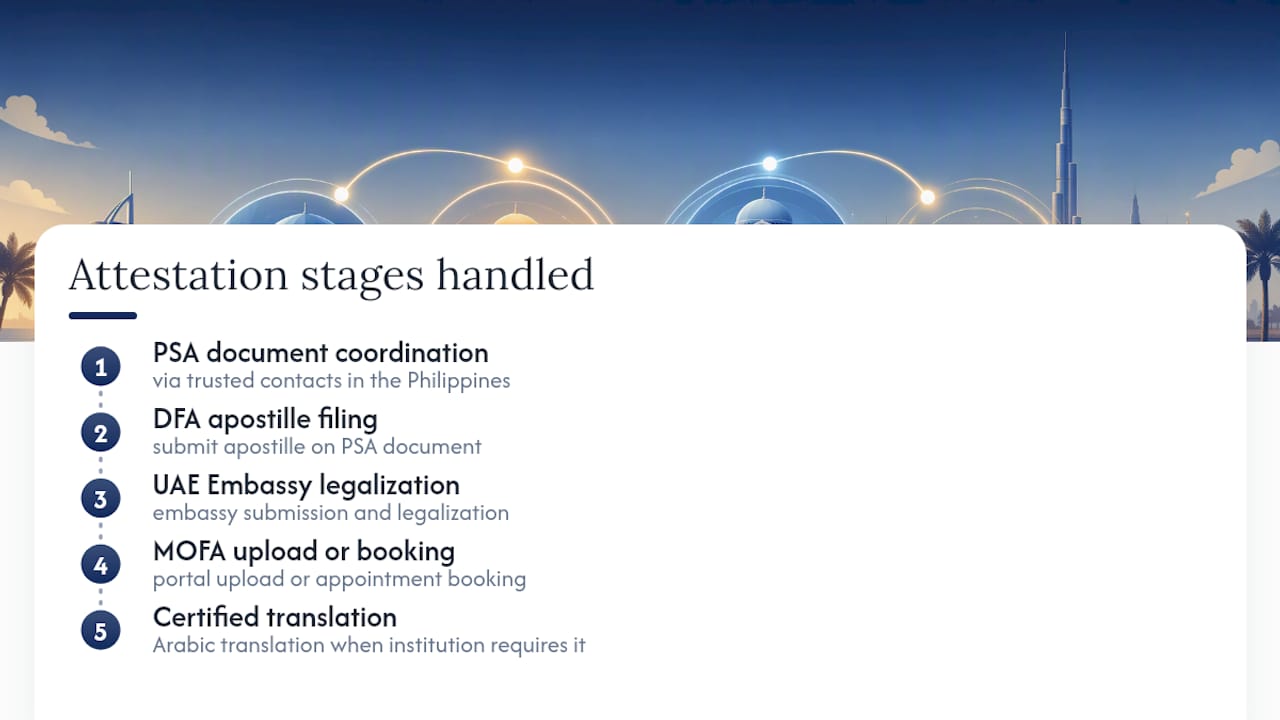
Harris N Charms handles the specific pieces Filipino expats in the UAE struggle with most: PSA document coordination through trusted contacts in the Philippines, DFA apostille filing, UAE Embassy legalization submission, MOFA portal upload or appointment booking, and certified translation when your receiving institution asks for Arabic.
Before reaching out, have three things ready: your original PSA death certificate (or a clear plan to obtain one), a passport copy, and a signed authorization letter if someone else is acting on your behalf. With those in hand, the process can start immediately instead of stalling on paperwork gaps.
Visit Harrisncharms to request a quote or schedule a consultation and get your document moving through the chain correctly the first time.
Where to Verify Fees and Steps Directly
Before booking any appointment or paying a third-party fee, confirm the current requirements yourself. Check the UAE MOFA attestation services page for portal access and processing times, the UAE Embassy Manila FAQs for legalization rules, and the Philippine Apostille FAQs for DFA booking details. These official pages carry the fees and timelines that actually apply to your case.
Sources
Recommended
Comments