
Employment Contract Attestation Steps for Filipino Expats

Employment contract attestation is the legal process of verifying that your employment agreement is genuine and officially recognized by UAE authorities. Without it, your contract holds no legal weight in the UAE, and your visa application, work permit, and labor rights all depend on completing this process correctly. The full employment contract attestation steps run through four official bodies: a Philippine notary public, the Department of Foreign Affairs (DFA) Philippines, the UAE Embassy in Manila, and the UAE Ministry of Foreign Affairs (MOFA). Filipino expatriates who skip or misorder these steps face document rejection, visa delays, and potential employment disputes.
What documents do you need before starting attestation?
The right documents make or break your attestation submission. Attestation verifies the integrity and authenticity of documents through official seals and signatures. Any missing item sends your file back to square one.
The core document set includes:
Original signed employment contract (both employer and employee signatures)
Passport copies of the employee, valid for at least six months
Passport-sized photos (typically two, but confirm with the receiving authority)
Authorization letter if a representative submits on your behalf
Notarization certificate from a certified Philippine notary public
Complete and correctly prepared document sets are the single most important factor in passing each authority’s requirements. A missing notarization or an unsigned page causes immediate rejection.
Document | Issuing or Certifying Authority |
Original employment contract | Employer |
Notarization certificate | Philippine notary public |
DFA authentication stamp | Department of Foreign Affairs, Philippines |
UAE Embassy attestation seal | UAE Embassy, Manila |
MOFA attestation stamp | UAE Ministry of Foreign Affairs |
Passport copy | Philippine Statistics Authority or issuing office |
Pro Tip: Before submitting anywhere, photocopy every document in your set and keep a separate folder. If originals are lost in transit, copies speed up replacement requests significantly.
Understanding what notarization requires in the UAE context helps you prepare the right format from the start. Philippine notaries must sign and seal the contract before any government body will accept it.
What are the employment contract attestation steps?
The attestation procedure for contracts follows a fixed sequence. Skipping or reversing any step invalidates the work done before it. Here is the exact order every Filipino expat must follow.
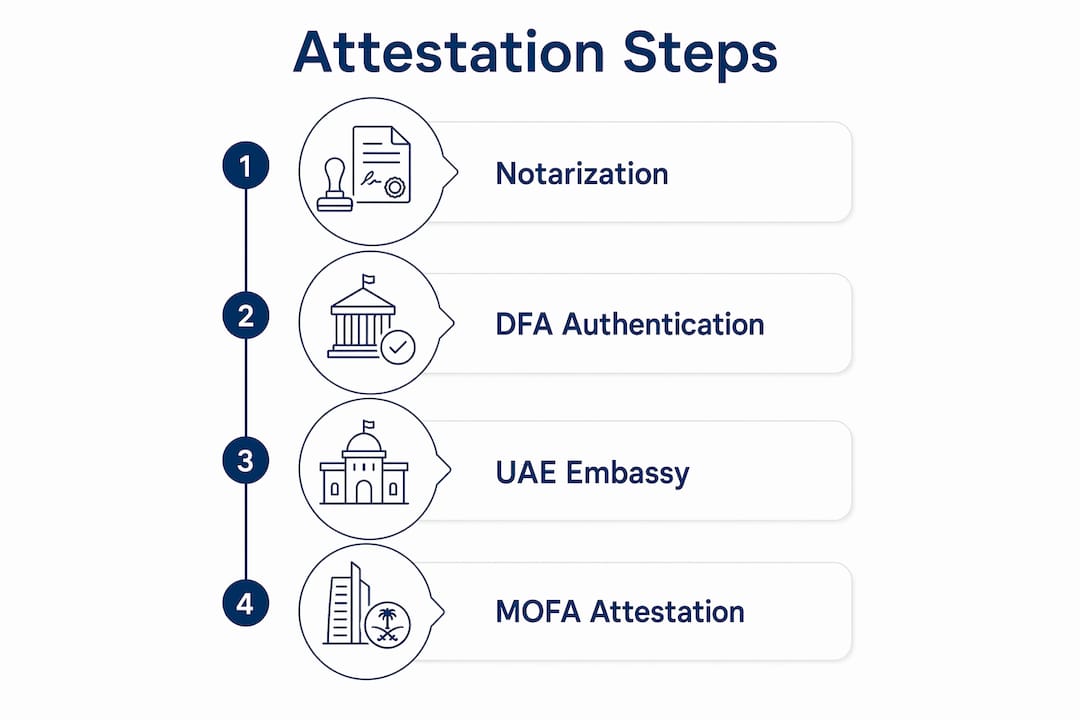
Step 1: Notarization by a Philippine notary public
Notarization by a certified notary is the mandatory first step before any government body will process your contract. The notary confirms that the signatures on the contract are genuine and that the document has not been altered. You must use a notary accredited in the Philippines, not a UAE-based notary, for this step.

Step 2: DFA Philippines authentication
After notarization, submit your contract to the Department of Foreign Affairs in the Philippines for authentication. The DFA places an official stamp or apostille that confirms the notary’s credentials are legitimate. Processing times at DFA vary. Walk-in appointments typically take one to three working days, while courier submissions can take up to two weeks.
Step 3: UAE Embassy attestation in Manila
Once the DFA has authenticated your contract, bring it to the UAE Embassy in Manila. The embassy verifies the DFA stamp and adds its own attestation seal. This step confirms that Philippine authorities have already validated the document. Fees and processing times at the UAE Embassy are set by the embassy and change periodically, so check the official UAE Embassy website before your appointment.
Step 4: MOFA attestation in the UAE
The final step happens inside the UAE. MOFA attestation is the last and most important stage, making your contract legally recognized within the UAE. You submit the embassy-attested contract to a MOFA service center or through the MOFA online portal. Once MOFA stamps your contract, the document is fully valid for visa processing, labor registration, and employer verification.
Pro Tip: Filipino expats who use attestation agents save significant time and reduce paperwork mistakes during the UAE employment contract legalization process. A reliable agent tracks your file at each stage and flags issues before they become rejections.
The full employment contract attestation workflow, from notarization to MOFA approval, typically takes three to six weeks when all documents are correct. Errors at any stage restart the clock.
What are the most common attestation challenges?
Filipino expats face predictable problems during the attestation procedure for contracts. Knowing them in advance cuts delays sharply.
Wrong attestation order. Filipino expatriates frequently misunderstand the required sequence and submit to the UAE Embassy before completing DFA authentication. The embassy rejects these files immediately.
Incomplete documentation. Delays at DFA Philippines or the UAE Embassy most often trace back to missing notarization or unsigned contract pages. Double-check every signature line before submission.
Expired passports or photos. Passport copies must reflect a valid document. Submitting a copy of a passport that expires within six months triggers rejection at multiple stages.
Unacceptable notary credentials. Not every notary public in the Philippines is accredited for international document use. Verify your notary’s accreditation with the Integrated Bar of the Philippines before paying for notarization.
Lost documents in transit. If you use courier services between Manila and the UAE, always choose a tracked, insured service. Keep scanned copies of every document before sending originals.
Signature and seal standards. Each authority checks that seals are clear and signatures match the contract exactly. Smudged seals or initials instead of full signatures cause rejection.
Choosing a reliable attestation service provider reduces exposure to all of these problems. Look for agencies with a verifiable track record handling Filipino expat documents specifically, not general document services. Learn who can legally attest documents in the UAE to avoid paying for services that have no official standing.
Why does employment contract attestation matter for your legal status?
Attestation is mandatory for visa approval and work permit processing for foreign workers in the UAE. The UAE government and employers require attested contracts to confirm authenticity and enforce labor laws. Without an attested contract, your employer cannot legally register you with the Ministry of Human Resources and Emiratisation (MOHRE), and your residency visa application will stall.
Attested employment contracts protect worker rights by proving that the agreed terms are genuine and formally recognized. Without attestation, a contract may be deemed invalid, which opens the door to visa cancellations and employment disputes you cannot easily resolve through official channels. The importance of contract attestation goes beyond paperwork. It is your legal proof that the job offer and its terms are real.
Employers also rely on attested contracts during internal audits and government inspections. A contract that lacks MOFA attestation creates compliance risk for the employer, which means many UAE companies now require attestation before your first working day. Understanding the full legal basis of contract attestation helps you negotiate from a position of knowledge, not confusion.
Key Takeaways
The employment contract attestation process follows four non-negotiable steps: notarization, DFA authentication, UAE Embassy attestation, and MOFA approval, and completing them in order is the only path to legal recognition in the UAE.
Point | Details |
Correct sequence is non-negotiable | Notarization must come first; MOFA attestation must come last. |
Document completeness prevents rejection | Gather originals, passport copies, photos, and notarization before submitting anywhere. |
MOFA is the final authority | Only MOFA attestation makes your contract legally valid inside the UAE. |
Attestation protects your work rights | Without it, contracts may be invalid, risking visa cancellation and labor disputes. |
Attestation agents reduce errors | Using a verified service provider cuts delays and catches mistakes before submission. |
What I have learned from watching Filipino expats navigate attestation
After working with Filipino expats on document attestation in the UAE, the pattern I see most often is not ignorance. It is overconfidence. People assume the process is straightforward because the steps look simple on paper. Then they arrive at the UAE Embassy with a DFA-stamped contract that was never notarized, and the whole timeline collapses.
The single biggest mistake is treating attestation as a one-time errand rather than a managed process. Each authority has its own standards, its own processing windows, and its own reasons to reject a file. The DFA can return documents for a notary credential issue that the notary themselves did not flag. The UAE Embassy can reject a contract because the employer’s signature does not match the company seal on file. MOFA can hold a file because the embassy stamp is slightly outside the designated area on the page.
My honest advice: start the process at least eight weeks before your intended start date in the UAE. That buffer absorbs one rejection cycle without derailing your employment timeline. Regulations also change. The UAE government periodically updates MOFA procedures, and the DFA adjusts its authentication requirements. Check official government portals directly before each submission, not just at the start of the process.
Filipino expats who treat attestation as a professional task, with a checklist, a timeline, and a backup plan, complete it without drama. Those who treat it as a formality spend weeks recovering from avoidable mistakes.
— Harris
How Harrisncharms helps Filipino expats complete attestation faster

Harrisncharms specializes in document attestation services for Filipino expats in the UAE. The team handles the full employment contract attestation workflow, from coordinating with Philippine notaries to submitting files at MOFA, so you do not have to manage each authority separately. Harrisncharms also provides direct guidance on document requirements, flags errors before submission, and tracks your file at every stage. If you are preparing your employment contract for UAE legal recognition and want expert support without the guesswork, contact Harrisncharms for a consultation tailored to your specific situation.
FAQ
What is the first step in employment contract attestation?
The first step is notarization by a certified Philippine notary public. No government authority will process your contract without this initial verification of signatures.
How long does the full attestation process take?
The complete employment contract attestation process typically takes three to six weeks when all documents are correct and submitted in the right order.
Can I skip DFA authentication and go directly to the UAE Embassy?
No. The UAE Embassy requires a DFA authentication stamp before it will process your contract. Submitting without it results in immediate rejection.
What happens if my employment contract is not attested?
An unattested contract may be deemed legally invalid in the UAE, which can result in visa cancellation, failed work permit registration, and unresolved labor disputes.
Do I need an attestation agent, or can I do this myself?
You can complete the process independently, but Filipino expats who use verified attestation agents experience fewer rejections and faster processing because agents know each authority’s current requirements.
Recommended
Comments