
Why Attestation Is Rejected: A Guide for Filipino Expats

Document attestation rejection occurs when submitted papers fail to meet the UAE authorities’ strict verification and authenticity requirements. For Filipino workers and expatriates in the UAE, a rejected attestation means delayed employment, stalled visa processing, and real financial loss. The most frequent causes of attestation rejection are an incomplete pre-attestation chain, document condition failures, and technical errors in digital submissions. Understanding these causes before you submit is the difference between a smooth process and weeks of costly resubmission.
Why attestation is rejected: the most common causes
The single biggest reason attestation is rejected in the UAE is an incomplete pre-attestation chain, particularly a missing UAE Embassy stamp from the issuing country. This means your document may have been authenticated in the Philippines by the Department of Foreign Affairs (DFA), but if the UAE Embassy in Manila has not endorsed it before submission to the UAE Ministry of Foreign Affairs (MOFA), the application fails immediately. The chain must be uninterrupted, and every step must appear in the correct sequence.

Beyond the chain, physical document condition is a major rejection trigger. Documents that are laminated, corrected with white-out, or carry faded seals are rejected because UAE attesting authorities cannot verify their authenticity. This rule catches many applicants off guard, especially those who laminated certificates years ago thinking it would protect them.
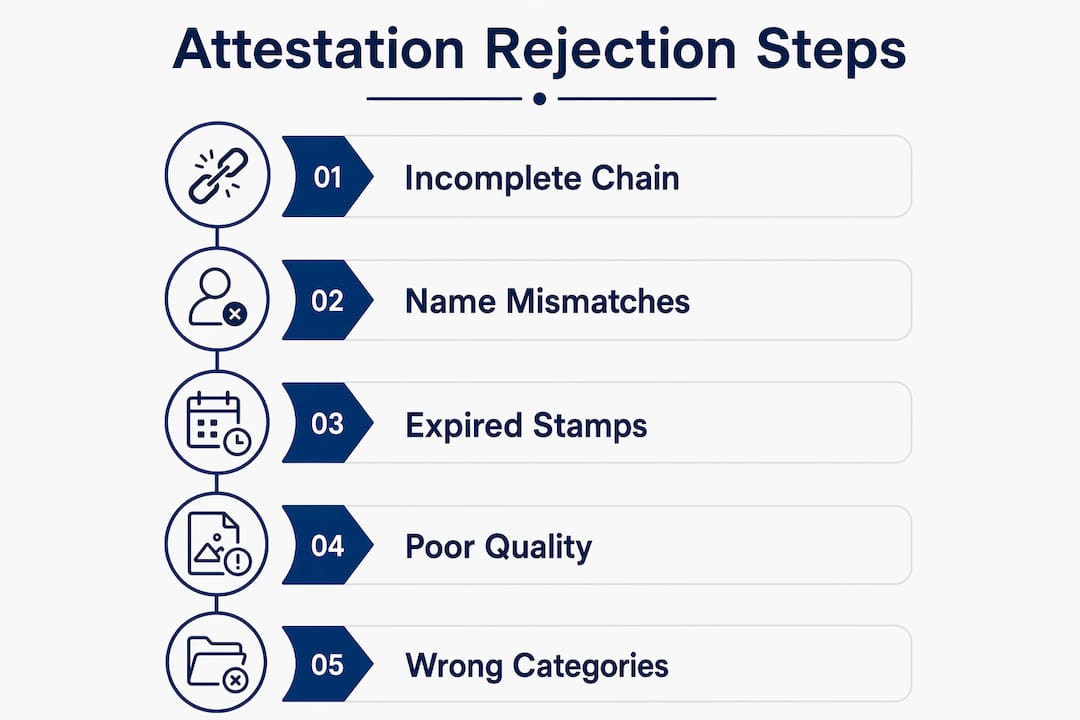
Here are the most common attestation rejection reasons Filipino expats encounter:
Incomplete attestation chain. Missing DFA authentication, UAE Embassy endorsement, or MOFA processing at any stage causes automatic rejection.
Laminated or physically altered documents. White-out corrections, torn pages, or unclear stamps make verification impossible.
Name mismatches across documents. Even a missing middle initial between your passport and your birth certificate can invalidate an attestation application.
Wrong document category in MOFA portal. Selecting “commercial” instead of “personal” for a birth certificate triggers an automatic mismatch.
Submitting copies instead of originals. Photocopies or uncertified copies are rejected outright. Authorities require original documents for attestation.
Pro Tip: Before you submit anything, lay all your documents side by side and compare every name field, date of birth, and ID number across each one. Inconsistencies that look minor to you are grounds for rejection.
How does the digital attestation process increase rejection risk?
The shift to digital attestation platforms has made the process faster in theory, but far less forgiving in practice. Digital submission systems enforce stricter validation, rejecting applications for blurry scans, missing pages, or incorrect file formats. A paper-based process might allow a clerk to flag an issue and ask for a correction. A digital system simply rejects and charges you the fee.
The most frequent digital errors Filipino expats make follow a recognizable pattern:
Uploading blurry or low-resolution scans. The system requires clear, high-resolution images where every seal and signature is legible.
Using incorrect file formats. Many portals accept only PDF files. Submitting a JPEG or PNG of your document results in an error.
Missing supporting documents. Forgetting to upload a passport copy or a supporting ID alongside the main document triggers an incomplete submission flag.
Sequence errors. Uploading documents out of the required attestation order confuses the system’s validation logic.
Ignoring translation requirements. Documents in Filipino or another non-Arabic language may require a certified Arabic translation before submission. Skipping this step causes rejection.
Digital systems eliminate the flexibility found in paper processes, so even minor errors or poor document quality can trigger rejection or costly delays. The practical implication for you is that preparation before you open the portal matters more than speed during submission.
Pro Tip: Scan your documents at a minimum of 300 DPI and review every page on a computer screen before uploading. What looks fine on a phone often appears blurry on a desktop review.
What steps can Filipino expats take to avoid attestation rejection?
Avoiding rejection is largely a preparation problem, not a luck problem. The attestation process follows a defined sequence, and every step has a specific requirement. Meeting those requirements before submission eliminates the majority of rejection scenarios.
Follow this checklist before submitting any document for UAE attestation:
Verify the full attestation chain. For Philippine-issued documents, the standard sequence is: notarization in the Philippines, DFA authentication, UAE Embassy in Manila endorsement, then UAE MOFA attestation. Confirm each step is complete before proceeding to the next. The OFW guide to document attestation covers this sequence in detail.
Check physical document condition. No lamination, no white-out, no torn edges, and no faded stamps. If a document is damaged, request a certified replacement before submitting.
Match personal details exactly. Your name, date of birth, and ID numbers must be identical across your passport, certificates, and any supporting documents. Even a nickname used on one document can cause a mismatch.
Select the correct document category in MOFA. Personal documents like birth certificates, marriage certificates, and educational degrees each have a specific classification. Wrong document classification causes silent system acceptance but triggers manual review rejection, and you lose the submission fee.
Submit originals only. Bring or upload the original document. If you need to keep the original, request a certified true copy from the issuing authority in the Philippines before starting the attestation process.
Requirement | What to check |
Attestation chain | DFA, UAE Embassy Manila, UAE MOFA all completed in order |
Document condition | No lamination, no corrections, stamps are clear and legible |
Personal details | Name and dates match exactly across passport and all certificates |
Document category | Correct MOFA portal classification selected |
Document type | Original submitted, not a photocopy |
The UAE attestation requirements for 2026 have specific updates that affect Filipino expats, so reviewing the latest procedural guidance before you begin is worth the time.
How do timing and institutional rules affect attestation approval?
Timing is a less obvious but equally serious cause of attestation refusal. Expired home country authentication stamps or certifications may no longer be accepted if validity periods lapse before UAE MOFA processing. This means a DFA authentication completed six months ago might be considered expired by the time you reach the MOFA submission stage, depending on the document type and issuing authority rules.
Notarization details also matter more than most applicants realize. Notary signature placement, stamp positions, and date format errors can be grounds for rejection even when the document itself is authentic. A notary stamp placed in the wrong section of a document or a date written in DD/MM/YYYY format when the portal expects MM/DD/YYYY creates a discrepancy that triggers rejection.
There is also a specific rule for situations where no UAE Embassy exists in the issuing country. In those cases, alternate accredited bodies must be pre-cleared to perform the attestation. Submitting without this pre-clearance results in rejection regardless of how well the rest of the document is prepared. For most Filipino expats submitting from the Philippines, the UAE Embassy in Manila handles this step. But if you are submitting documents issued in a country where you previously worked or studied, this rule applies to you.
Resubmission after rejection also has timing consequences. Some authentication stamps have short validity windows, so a rejection that forces resubmission may require you to restart the home country authentication process entirely. Understanding how to notarize documents for overseas use correctly the first time prevents this cycle.
Key takeaways
Attestation rejection in the UAE is almost always preventable when you understand the required sequence, document standards, and digital submission rules before you begin.
Point | Details |
Complete the attestation chain | DFA, UAE Embassy, and MOFA steps must all be completed in the correct order. |
Check physical document condition | Laminated, corrected, or unclear documents are rejected immediately. |
Match all personal details exactly | Even a missing middle initial between documents can invalidate your application. |
Use correct MOFA classifications | Wrong document categories trigger manual review rejection and fee loss. |
Submit before stamps expire | Expired home country authentications require restarting the process from the beginning. |
What I’ve learned from watching attestation rejections happen repeatedly
I have seen the same mistakes cause rejection over and over, and the pattern is always the same. Someone rushes the process, assumes a step is optional, or trusts a photocopy because the original is “somewhere safe.” The result is a rejection letter, a lost fee, and another two to four weeks of waiting.
The misconception I encounter most often is that the UAE Embassy attestation in Manila is optional or can be skipped if you have DFA authentication. It cannot. The document attestation guide for Filipino expats makes this clear, but many applicants still skip this step because someone told them it was not necessary. It is always necessary.
What I would tell every Filipino expat preparing for attestation is this: read the rejection notice carefully if you receive one. The notice tells you exactly which step failed and why. Most people ignore the detail and resubmit the same document with the same problem. The notice is your roadmap for fixing the issue correctly the first time.
Patience and precision matter more than speed here. A correctly prepared submission that takes two extra days to prepare will always beat a rushed submission that gets rejected and costs you three weeks.
— Harris
How Harrisncharms helps Filipino expats avoid attestation rejection
Harrisncharms specializes in document attestation services for Filipino expats in the UAE, with direct experience in the exact rejection scenarios described in this article.

If you are unsure whether your documents meet the 2026 UAE attestation requirements, or if you have already received a rejection and need to understand your next steps, Harrisncharms provides consultation and end-to-end processing support. The team stays current with MOFA procedural updates and knows the specific requirements for Philippine-issued documents. Working with a specialist reduces the risk of costly resubmission and gets your documents processed correctly the first time. Visit Harrisncharms to start your consultation today.
FAQ
Why is my attestation rejected even with DFA authentication?
DFA authentication alone is not sufficient for UAE MOFA attestation. The UAE Embassy in Manila must also endorse the document before it reaches MOFA, and skipping this step is the leading cause of rejection.
Can a laminated document be attested in the UAE?
Laminated documents are rejected because UAE authorities cannot verify the authenticity of seals and signatures beneath the lamination. You must obtain a certified replacement from the issuing authority before submitting.
What happens if my name on my passport differs from my certificate?
Even minor name differences, such as a missing middle initial or a nickname, cause automatic rejection. All personal details must match exactly across every document in your submission.
Can attestation be appealed after rejection?
Rejection is not typically appealed. Instead, you correct the specific issue identified in the rejection notice and resubmit. If home country authentication stamps have expired during the delay, you may need to restart that portion of the process.
How do I know which document category to select in the MOFA portal?
Personal documents like birth certificates, marriage certificates, and educational degrees each have a designated category in the MOFA portal. Selecting the wrong one, such as marking a personal document as commercial, triggers rejection. Review the authorized attestation entities guide for classification guidance specific to Filipino expats.
Recommended
Comments