
Power of Attorney Attestation: A Guide for Expats

Power of attorney attestation is the official legal process that authenticates a Power of Attorney (POA) document, making it recognized and enforceable by banks, courts, and government authorities in the UAE. Without this process, a POA is simply a signed paper with no legal standing. For Filipino expats managing property, finances, or family matters from abroad, understanding what is power of attorney attestation is not optional. It is the difference between a document that works and one that gets rejected at the counter. This guide walks you through every step, the legal basis behind the requirement, and the mistakes that cause costly delays.
What is power of attorney attestation and why does it matter?
Power of attorney attestation is the sequential verification process through which a POA document receives official stamps and signatures from authorized government bodies, confirming that the document is genuine and legally valid. The term most professionals use is “legalization” when the process crosses international borders, but attestation is the standard term used within the UAE system.
A POA grants one person, called the agent or attorney-in-fact, the legal authority to act on behalf of another person, called the principal. That authority only becomes enforceable once the document passes through attestation. Banks in the UAE will not process transactions, courts will not accept filings, and government departments will not register property transfers based on an unattested POA. Attestation is what converts a private agreement into a publicly recognized legal instrument.

The process matters especially for Filipino expats who need someone back home, or a representative in the UAE, to handle legal or financial matters on their behalf. A document attestation guide specific to expats outlines the full scope of what this involves, from initial preparation through final submission.
What steps are involved in power of attorney attestation?
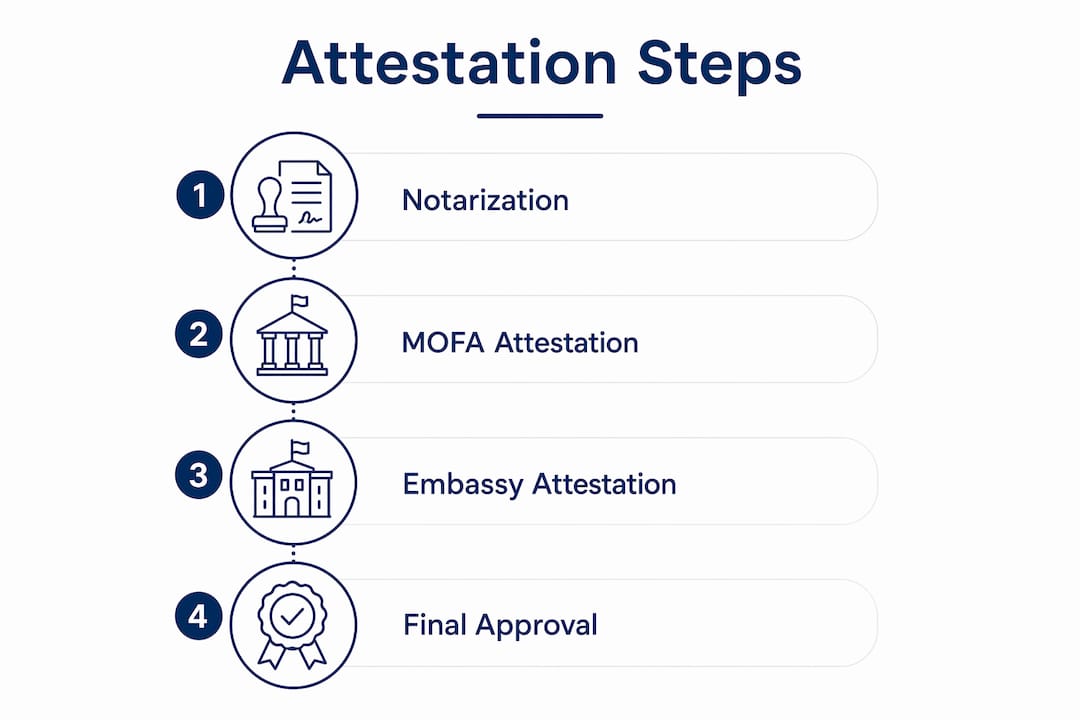
The attestation process follows a strict sequence. Skipping or reversing any step causes rejection, and you must restart from the beginning. Here is the correct order for a UAE-issued POA:
Draft and sign the POA before a licensed notary public in the UAE. The notary verifies the identity of the principal and witnesses the signing.
Notarization by a UAE notary public. Notarization in the UAE typically takes 1 to 2 working days. This step gives the document its first layer of official recognition.
Ministry of Foreign Affairs (MOFA) attestation. After notarization, the document goes to the UAE Ministry of Foreign Affairs, which adds its official stamp. MOFA processing takes 1 to 3 working days.
Certified Arabic translation, if the document is in English or another language. Many government departments and banks require an Arabic version alongside the original.
Submission to the receiving authority, whether that is a bank, court, land department, or other institution.
For a foreign-issued POA, the sequence is longer and involves additional stages before the document even reaches the UAE. The attestation requirements for 2026 cover the updated procedures in detail.
Pro Tip: Never submit your POA to MOFA before completing notarization. The attestation process is sequence-dependent, and performing steps out of order results in automatic rejection and a full restart.
Processing timelines matter when you are working against a deadline. Notarization takes 1 to 2 days, MOFA takes 1 to 3 days, and foreign-issued POA attestation requires 7 to 12 working days depending on embassy processing speed. Build that buffer into any transaction timeline.
Why is POA attestation legally required in the UAE?
A POA is legally unenforceable under UAE law without notarization, as established by Federal Law No. (5) of 1985 and Federal Law No. (4) of 2013. These laws set the legal framework for notarial acts in the UAE and define what constitutes a valid legal document. Attestation is not a bureaucratic formality. It is a statutory requirement.
“Without official stamps of authenticity from origin and UAE authorities, local institutions cannot recognize agent authority.” This is the core legal implication of skipping any attestation step. An unattested POA exposes both the principal and the agent to legal risk, including fraud liability and unenforceable transactions.
The fraud prevention function of attestation is significant. When a notary and government body verify the identities of the parties and the authenticity of signatures, they create a documented chain of accountability. If someone attempts to forge a POA, that chain breaks, and the document fails verification. This protects principals from unauthorized use of their authority.
Practical consequences of using an unattested POA are immediate. Emirates NBD, Abu Dhabi Commercial Bank, and the Dubai Land Department all require fully attested POAs before processing any transaction on behalf of an agent. Courts in Dubai and Abu Dhabi reject unattested POAs outright. The legal implications of power of attorney extend beyond inconvenience. An unattested document used in a transaction can render that transaction void.
How do local and foreign POA attestation processes differ?
The difference between a UAE-issued and a foreign-issued POA is significant in terms of both complexity and time. The table below compares the two processes directly.
Factor | UAE-issued POA | Foreign-issued POA |
Starting point | UAE notary public | Notary public in country of origin |
Government stages | MOFA only | Home department, Ministry of External Affairs, UAE embassy, then MOFA |
Typical timeline | 3 to 5 working days total | 7 to 12 working days, sometimes longer |
Translation required | Often required for Arabic | Required for Arabic; original language translation may also be needed |
Embassy involvement | Not required | UAE embassy in country of origin must attest |
Risk of rejection | Lower if steps are followed | Higher due to multi-country chain |
For a POA issued in the Philippines and intended for use in the UAE, the process requires notarization in the Philippines, authentication by the Department of Foreign Affairs (DFA) in Manila, attestation by the UAE embassy in Manila, and finally MOFA attestation in the UAE. Validating a foreign-issued POA for use in the UAE requires attestation by the country of origin’s competent authorities, then the UAE embassy, and finally MOFA. Each stage must be completed before the next begins.
Pro Tip: If your POA was issued in the Philippines, confirm with the DFA Manila that your document type qualifies for authentication before starting the process. Some document categories require additional steps that can add days to the timeline.
Preparing attestation papers correctly from the start is the single most effective way to avoid delays in the foreign attestation chain. Errors at the origin country stage mean the entire process restarts.
How to get your POA attestation accepted the first time
Rejection is almost always preventable. The main reason for POA rejection is chain-breaking, which means missing a step or failing to provide a certified Arabic translation. Here is what to verify before submitting your document at any stage:
Follow the correct sequence without exception. Attestation is sequence-dependent. No authority will accept a document where a later step was completed before an earlier one.
Include a certified Arabic translation when submitting to UAE government departments or banks. Certified Arabic translations are legally required for submission of POAs to government departments and banks in the UAE. A general translation is not sufficient. It must be certified by a licensed translator.
Verify all signatures and stamps before submission. A missing signature or an unclear stamp from any stage in the chain will cause rejection.
Do not alter the document after any attestation step. Any change to the document after it has been stamped invalidates all previous attestations. The document must be redrafted and the process restarted.
Check document validity. A notarized POA is generally valid for up to 3 years in the UAE, but some authorities require more recent documents for sensitive transactions like property sales. Confirm validity requirements with the receiving institution before submitting.
Use a licensed notary and a reputable attestation service. Errors introduced by unqualified service providers are one of the most common causes of rejection. Knowing who can attest documents in the UAE helps you choose the right professional from the start.
Delays and rejections rarely come from incorrect POA content. They come from procedural errors in the attestation sequence or missing translations. Getting the procedure right matters more than getting the wording perfect.
Key takeaways
Power of attorney attestation is a legally mandatory, sequence-dependent process that converts a signed POA into an enforceable legal instrument recognized by UAE banks, courts, and government authorities.
Point | Details |
Attestation is legally required | UAE Federal Law No. (5) of 1985 and No. (4) of 2013 make notarization mandatory for POA enforceability. |
Sequence cannot be skipped | Performing steps out of order causes automatic rejection and a full process restart. |
Foreign POAs take longer | A Philippines-issued POA requires DFA, UAE embassy, and MOFA attestation, taking 7 to 12 working days. |
Arabic translation is mandatory | Certified Arabic translations are required for submission to UAE government departments and banks. |
Validity has a time limit | A notarized POA is valid for up to 3 years, but some institutions require more recent documents. |
What I’ve learned from watching POA attestations go wrong
I have seen Filipino expats lose weeks of time, and in some cases miss critical property deadlines, because of one missing stamp or an uncertified translation. The frustrating part is that the POA content itself was perfectly written. The authority was clear, the parties were identified correctly, and the scope was appropriate. The document still got rejected because the attestation chain had a gap.
The most common gap I see is the Arabic translation. People assume that because the POA is in English, and the notary read it in English, the UAE institution will accept it in English. Banks and land departments in the UAE operate on Arabic documentation. A non-certified translation, or no translation at all, stops the process immediately.
The second pattern I notice is urgency-driven shortcuts. Someone needs a property transfer completed by a specific date, so they try to submit to MOFA before the embassy has attested. The result is always the same: rejection and a restart that takes longer than the original process would have.
My honest recommendation is to start the attestation process at least three weeks before you need the document to be active, especially for foreign-issued POAs. That buffer absorbs embassy delays, translation turnaround, and any correction requests. Attestation regulations in the UAE have also been updated in recent years, so working with a professional service that tracks current requirements is worth the investment.
— Harris
How Harrisncharms can help with your POA attestation
Harrisncharms specializes in document attestation services for Filipino expats in the UAE, including power of attorney attestation from start to finish.

If you are dealing with a UAE-issued or Philippines-issued POA and need it attested correctly and on time, Harrisncharms handles the full process: notarization coordination, MOFA submission, certified Arabic translation, and embassy legalization for foreign documents. The team knows the current requirements, tracks processing timelines, and catches errors before they cause rejections. Visit Harrisncharms attestation services to get started or ask a question about your specific document situation.
FAQ
What is power of attorney attestation in simple terms?
Power of attorney attestation is the official process of getting a POA document verified and stamped by authorized government bodies so that banks, courts, and other institutions legally recognize it.
How long does POA attestation take in the UAE?
Notarization takes 1 to 2 working days, MOFA attestation takes 1 to 3 working days, and foreign-issued POA attestation takes 7 to 12 working days depending on embassy processing.
Can a POA be used in the UAE without attestation?
No. Under UAE Federal Law No. (5) of 1985 and Federal Law No. (4) of 2013, a POA is legally unenforceable without notarization and the required attestation steps.
Why do UAE banks and courts reject unattested POAs?
Without official stamps from the notary and relevant government authorities, institutions have no way to verify the document’s authenticity or the agent’s legal authority, so they reject it outright.
Is an Arabic translation required for POA attestation?
Yes. Certified Arabic translations are legally required when submitting a POA to UAE government departments and banks, and a general translation does not meet this requirement.
Recommended
Comments