
Apostille Attestation Procedure Guide for Filipino Expats in UAE

Picture this: you’ve just landed your dream job in Dubai, your employer is waiting on your credentials, and then you learn that your Philippine documents aren’t accepted because the apostille attestation procedure wasn’t completed correctly. This exact scenario plays out regularly for Filipino workers across the UAE, and it can delay or even cancel an employment offer. Getting your documents right before you travel isn’t just paperwork—it’s the difference between starting your new life on time or scrambling to fix avoidable errors from thousands of miles away. Understanding the apostille attestation procedure before you leave the Philippines can save you time, money, and unnecessary stress.
Table of Contents
Key Takeaways of apostille attestation procedure
Point | Details |
DFA Apostille is step one | For UAE use, you must get the DFA Apostille before starting embassy attestation. |
Valid notarization is essential | Documents notarized by an expired commission will be rejected, so double-check your notary’s credentials. |
Online appointment required | Most applicants must book DFA Apostille appointments online and cannot walk in. |
UAE accepts only full attestation | UAE authorities require DFA Apostille, embassy, and MOFA attestation for legal acceptance. |
Start early to avoid delays | Appointment slots fill quickly, and each step takes time, so plan far ahead of employment deadlines. |
What is apostille attestation and why does it matter for UAE?
Understanding the process starts with one key distinction. An apostille is a form of single-step legalization that allows a document from one country to be recognized in another country that belongs to the Hague Apostille Convention. The Philippines issues this apostille through the Department of Foreign Affairs, or DFA. For most convention countries, that apostille stamp is all you need.
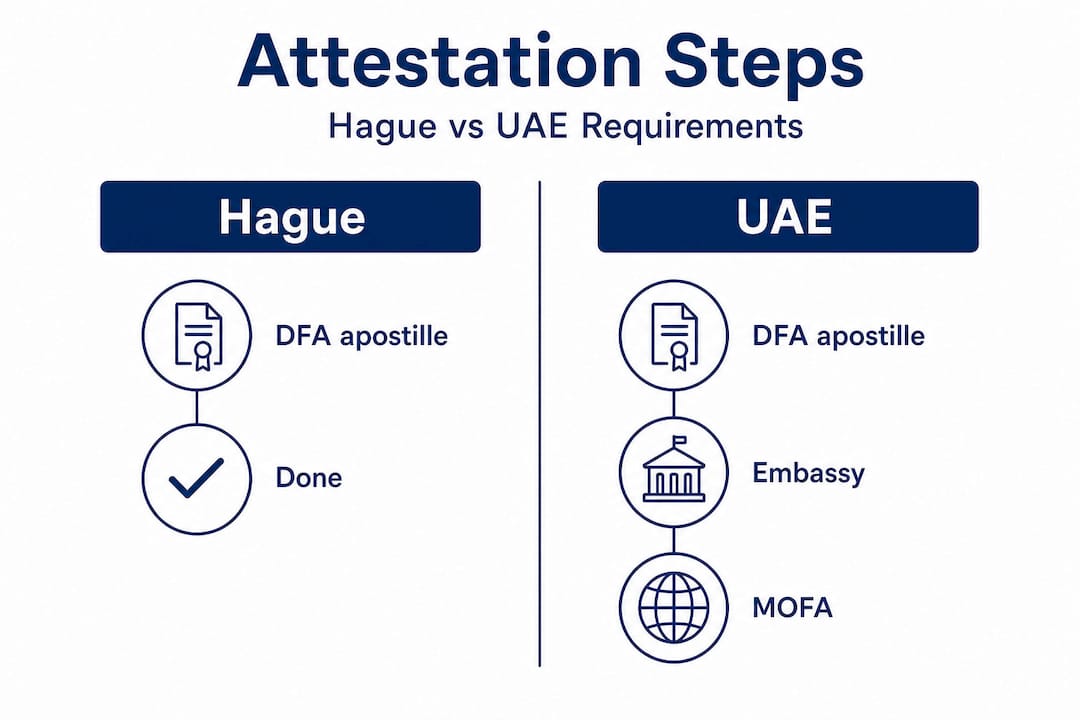
The UAE operates differently. Because the UAE has its own bilateral requirements for foreign documents, Philippine documents for UAE use require additional steps beyond the DFA apostille. Specifically, you need UAE Embassy attestation in Manila and then UAE Ministry of Foreign Affairs and International Cooperation (MOFA) attestation once you arrive in the UAE.
Here’s a side-by-side comparison so you can see exactly how the UAE requirement differs from other Hague Convention countries:
Requirement | Hague convention countries | UAE |
DFA apostille | Required | Required |
UAE Embassy attestation | Not required | Required |
UAE MOFA attestation | Not required | Required |
Total steps | 1 | 3 |
Estimated processing time | 3 to 5 days | 2 to 4 weeks |
This difference catches many Filipino expats off guard. Some assume that once their document carries the DFA apostille stamp, it’s fully accepted anywhere. For UAE employment, residency, or legal purposes, that assumption leads to serious delays. Understanding legalization vs attestation early in the process can save you from starting over.
A significant portion of UAE job offer rejections or employment delays among Filipino workers trace back to incomplete attestation. Documents missing either the UAE Embassy step or the MOFA finalization are the most common reasons documents get turned away by UAE employers and government offices.
Preparing your document: requirements and common mistakes
Once you understand what the process requires, you need to make sure your documents are ready at the source. Philippine documents generally fall into three categories: private documents, government-issued documents, and school or academic documents. Each category has different preparation rules.

Here’s what each document type typically requires before DFA submission:
Document type | Notarization required | Government certification | DFA apostille |
Affidavits and private contracts | Yes, by valid notary | Sometimes | Yes |
Birth, marriage, death certificates | No | PSA issuance | Yes |
Academic records (TOR, diplomas) | Sometimes | School registrar | Yes |
Employment-related documents | Yes | DOLE or employer | Yes |
For private notarized documents, the notarization must be done with a valid, current notarial commission. After notarization, documents are submitted to the DFA for apostille processing following an online appointment. This sounds simple, but it’s where most people make mistakes.
The top three preparation mistakes we see consistently:
Expired notarial commission. A notary public’s commission has an expiration date. If your document was notarized after the commission expired, the DFA will reject it outright. Always ask the notary to show you their current commission before signing.
Incomplete or inconsistent names. Your name must appear consistently across all documents. Even a middle name abbreviation that differs from your passport can cause issues.
Missing supporting documents. Submitting an affidavit without the required attachments, or a diploma without a school certification letter, can delay processing.
“A rejected document doesn’t just waste your fee. It can push your employment start date back by weeks while you re-notarize, rebook, and resubmit. Prevention is always cheaper than correction.”
Pro Tip: Before going to any notary, ask them to show you their current notarial commission certificate. Cross-check the expiration date and the territorial jurisdiction. A notary in Makati cannot notarize a document if their commission is for Quezon City.
For thorough preparation before you submit anything to the DFA, review these document preparation tips to ensure your papers are in order. If you’re dealing with affidavits specifically, the affidavit attestation guide walks through every requirement in detail.
Booking an appointment with DFA for apostille attestation
With your documents properly prepared, the next step is scheduling your DFA appointment. The DFA apostille application is appointment-driven. Walk-ins are not accepted in general, which means you cannot simply show up at a DFA office and expect same-day service.
Here’s the step-by-step process for booking your appointment:
Visit the official DFA apostille portal at apostille.gov.ph.
Create or log in to your DFA appointment account.
Select the DFA office nearest to you or most convenient for travel.
Choose your preferred appointment date and time slot.
Fill in the required details including document type and applicant information.
Confirm your appointment and print or save your confirmation slip.
Prepare payment. The apostille fee per document is payable at the DFA office.
Bring your original documents, one set of photocopies, your government-issued ID, and your printed appointment confirmation on the day of your visit.
There are specific exceptions to the appointment-only rule. Senior citizens (60 years old and above), persons with disabilities (PWD), and pregnant applicants may be accommodated as walk-ins at most DFA offices. If you fall into one of these categories, bring supporting documents like a senior citizen ID, PWD card, or a medical certificate confirming pregnancy.
Pro Tip: Book your DFA appointment at least three to four weeks before your employment contract start date. Appointment slots fill up quickly, especially near the end of the month. Factor in processing time on top of your appointment date because DFA may take additional days to release the apostilled document.
For a broader overview of how the entire attestation chain works before and after the DFA step, the Philippines attestation guide is a practical reference point.
UAE-side attestation: Embassy and MOFA requirements
Getting your DFA apostille is a major milestone, but for UAE-bound documents, it’s only the midpoint of the process. As noted earlier, UAE attestation requires additional steps beyond the Philippine apostille. Here’s the complete sequential process once your DFA apostille is secured:
DFA apostille. Your document receives the official apostille from the Philippine DFA, confirming its authenticity for international use.
UAE Embassy attestation in Manila. Submit your apostilled document to the UAE Embassy in Manila for attestation. This confirms the document’s validity from the UAE government’s perspective while the document is still in the Philippines.
UAE MOFA attestation. After arriving in the UAE, the document must be submitted to the UAE Ministry of Foreign Affairs and International Cooperation for final attestation. This is the step that makes your document fully recognized within the UAE’s legal and employment systems.
Here are practical tips for the MOFA finalization step that many people overlook:
Submit documents while they are still within their validity window. Some documents, especially medical certificates, have a short shelf life.
Bring both originals and clear photocopies to the MOFA office.
Confirm whether your document type requires translation into Arabic before MOFA submission. Some employers and government offices in the UAE require a certified Arabic translation alongside the attested original.
Keep all your attestation receipts. If any step needs to be traced or repeated, having proof of each stage saves significant time.
Here’s how UAE requirements compare to typical convention country requirements at a glance:
Attestation stage | Convention country (non-UAE) | UAE |
DFA apostille | Final step | First step |
Embassy attestation | Not needed | Mandatory |
MOFA attestation | Not needed | Mandatory |
Arabic translation | Rarely required | Often required |
For documents related to schooling or academics, the school document attestation process has its own nuances. And if you need a broader overview of how to legalize documents for UAE use, that resource covers the full chain in detail.
Verifying your attestation: Checking acceptance and troubleshooting
Once all three attestation stages are complete, your document should be fully accepted in the UAE. But verification matters. Don’t assume everything is in order without confirming it.
Here’s how to verify and troubleshoot:
Ask your employer or HR department to confirm the document meets their internal requirements before you finalize onboarding.
If your document is for a government transaction (like visa processing or residency applications), confirm with the relevant UAE authority that the attestation format they require is satisfied.
Check the physical condition of each stamp and seal. Faded stamps or unclear seals can raise questions even after proper attestation.
Keep digital copies of every page, including all attestation seals and stamps, as a backup.
One important edge case to understand involves e-Apostille. The e-Apostille acceptance rules depend on whether the destination country recognizes it as part of the Hague Apostille Convention’s electronic framework. The UAE does not accept e-Apostille for employment or legal purposes. You must have a physical hard-copy apostille with proper stamps, followed by the UAE Embassy and MOFA attestation on the same physical document.
If your document gets rejected:
Identify exactly which stage failed. Was it rejected at DFA, UAE Embassy, or MOFA?
Request written feedback from the rejecting authority so you know the specific reason.
Re-notarize if the notarial commission was flagged as expired or invalid.
Contact a professional attestation service immediately if you’re under a deadline.
Pro Tip: If you’re running close to an employment deadline and a document has been rejected, contact an established agency attestation guide service right away. Professional agencies often have faster processing channels and direct contacts at key offices that can accelerate resolution. The apostille service benefits for Filipinos in the UAE are especially valuable when time is tight.
Our perspective: The reality expats face and how to truly succeed
We’ve worked with hundreds of Filipino expats navigating this process, and here’s what we’ve observed that most step-by-step guides won’t tell you.
The single biggest misconception is that the DFA apostille is the finish line. It isn’t. It’s the starting line for UAE-bound documents. Expats who treat the apostille as the final step end up arriving in the UAE with documents that look official but are legally incomplete for local use. That misunderstanding costs people days of work, re-processing fees, and sometimes their employment offers.
The second hard truth is about notarization. More documents are rejected at DFA because of notarial problems than any other reason. Notaries with expired commissions, notaries operating outside their territorial jurisdiction, and notarized documents with incomplete jurat language are the top culprits. Many expats don’t know to check these things. They trust the notary without verification. By the time DFA rejects the document, they’re already running behind schedule.
Timing is the third major issue. The apostille appointment system, the UAE Embassy queue in Manila, and the MOFA office in the UAE each have their own processing timelines. Combining them realistically means four to six weeks from start to finish, sometimes longer. Expats who start this process two weeks before their employment start date are almost always too late.
Our recommendation is simple: start the attestation process the moment you receive your job offer letter. Don’t wait for your employment contract. And if you’re managing multiple documents or working under a tight deadline, consider professional attestation benefits for Filipinos in UAE to offload the complexity to people who handle it every day. The cost of professional help is almost always less than the cost of a delayed start date.
Next steps: Simplify your attestation journey with trusted support
Navigating the apostille and UAE attestation chain on your own is possible, but it requires careful timing, accurate document preparation, and knowledge of each step in sequence. For many Filipino expats juggling job preparation and relocation logistics at the same time, a single missed step can cause costly setbacks.

If you want to skip the guesswork and get your documents handled correctly the first time, trusted attestation support is available specifically for Filipino expats in the UAE. From DFA apostille preparation through UAE Embassy attestation and MOFA finalization, a reliable service partner makes the entire process faster and far less stressful. Your employment offer deserves documents that arrive ready and accepted.
Frequently asked questions
Can I use e-Apostille documents for UAE employment purposes?
No. The UAE requires a physical hard-copy apostille combined with UAE Embassy and MOFA attestation. E-Apostille acceptance depends on the destination country’s membership framework, and the UAE does not accept it for employment or legal use.
How long does the DFA apostille process take in the Philippines?
Timing varies based on appointment availability and document complexity, but expect several days for scheduling alone plus additional processing days. For UAE-bound documents, budget at least four to six weeks total for the full chain.
What happens if my document was notarized by an expired commission?
Documents notarized under an expired commission are rejected by the DFA. You must have the document re-notarized by a notary with a valid, current commission before resubmitting your apostille application.
Do I need UAE Embassy attestation for employment paperwork?
Yes. Nearly all employment-related documents require UAE Embassy attestation after DFA apostille. The full UAE process includes DFA apostille, UAE Embassy attestation in Manila, and MOFA attestation in the UAE before a document is accepted for employment purposes.
Are walk-ins allowed for DFA apostille applications?
Walk-ins are only allowed for senior citizens, PWD applicants, and pregnant applicants. All other applicants must book an appointment online through the official DFA apostille portal before visiting any DFA office.
Recommended
Comments